In FY2025, federal agencies obligated $150.5 billion on contracts in September alone. February brought in $44.1 billion. One month was more than three times the other.
Everyone in GovCon knows "the year-end rush" exists. Fewer people have looked at how lopsided it really is, or at what it means for when you write, when you price and when you need cash in the bank. It's mid-April, FY2026 is a little past halfway, and the Q4 surge is about five months out. Now is the time to look.
We track this in GovIntel, our federal contracting data warehouse. Everything below comes from contract action records for FY2023 through January 15, 2026, plus SAM.gov notice counts. One caveat up front: DoD award data runs about 90 days behind, so the FY2026 figures stop at mid-January.
💡 From the GovIntel desk this week
- 6 of 6 GAO protest decisions from April 9–15 were denied, one with corrective action and none recommending costs. Denials remain the norm.
- 27 protest grounds challenged technical evaluations in GAO decisions since mid-January, the most common ground, yet only 1 sat in a sustained decision. Scoring challenges rarely win.
- 2,379 small business set-aside solicitations hit SAM.gov this week (total set-aside category), up from 2,229 the week before.
- 93 women-owned small business set-aside solicitations posted this week, up from 65 the prior week. SDVOSB set-asides also rose, to 382 from 346.
- 4.21% is the 12-month rise in wages and salaries across all industries in Q1 2026. Keep it in mind when pricing fixed-rate bids and option years.
Data as of April 15, 2026, from IPS GovIntel: federal awards, opportunities, protests, rules and budgets, updated daily.
The year has a shape, and it's a hockey stick
Here's FY2025 by month:
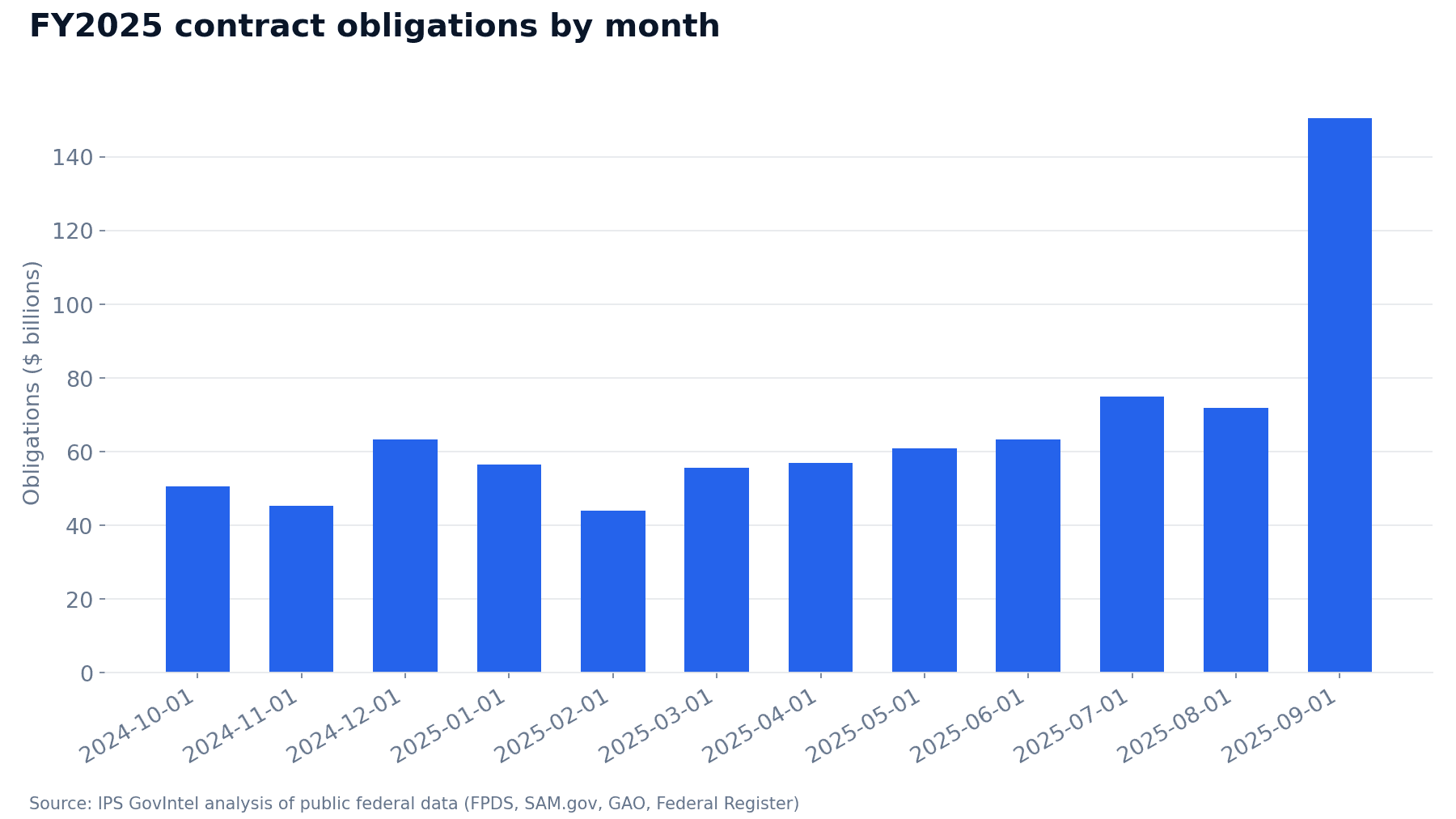
Most months fell between about $44 billion and $64 billion. July rose to $75.0 billion and August came in at $71.9 billion. Then September hit $150.5 billion, almost exactly double July.
This isn't a one-off. September came in at $122.5 billion in FY2023, $131.9 billion in FY2024 and $150.5 billion in FY2025. The spike is getting bigger.
By quarter, FY2025's fourth quarter totaled $297.4 billion, against $159.5 billion in the first quarter. FY2024 showed the same pattern: $268.5 billion in Q4 against $147.6 billion in Q1.
The quiet stretch is just as consistent. In each of the three years, October and November were among the four lowest months. In FY2025 they brought in $50.7 billion and $45.4 billion. December then jumps ($63.4 billion in FY2025, $65.7 billion in FY2024), and the middle of the year runs well below September.
The new-award data shows the same thing. Base awards (modification zero) in FY2025 carried $73.6 billion in September across 592,337 actions. No other month topped $34 billion.
One thing September doesn't change much is competition. The share of new awards that drew only a single offer ranged from 33.9% to 38.5% across every month of FY2025, and September landed at 36.0%. The rush brings more awards, not obviously easier ones.
Some agencies are far more back-loaded than others
The September effect varies a lot by customer. Here's the share of each large agency's FY2025 obligations that landed in September:
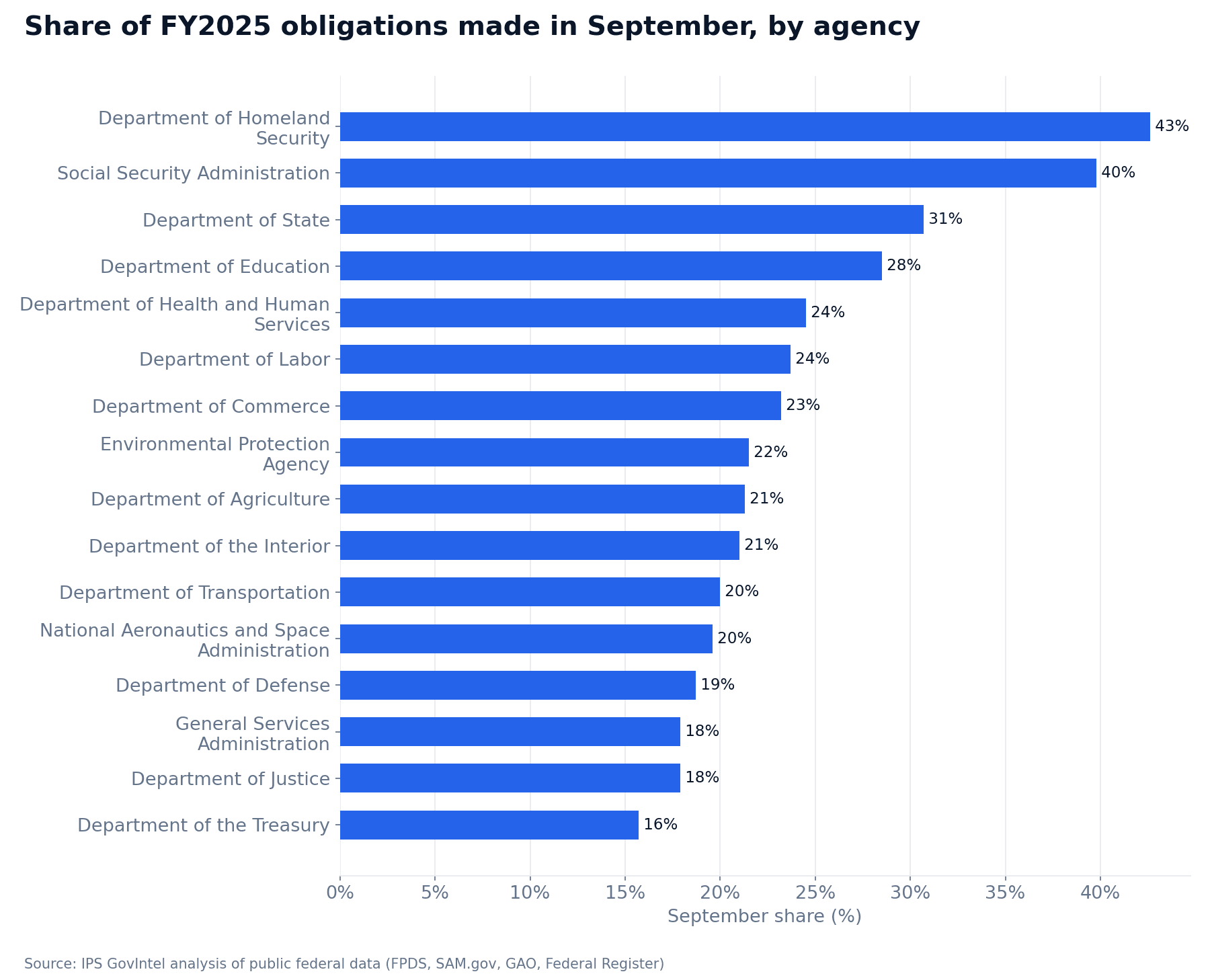
The Department of Homeland Security put 42.6% of its FY2025 contract dollars ($12.1 billion of $28.4 billion) into September. The Social Security Administration was close behind at 39.8%. State (30.7%) and Education (28.5%) were also well above the 18.7% DoD posted.
At the other end, Energy obligated just 9.0% in September and VA 12.9%. DoD, the biggest buyer by a wide margin at $492.7 billion, put 18.7% ($92.4 billion) into September.
This matters for planning. If your customers are DHS or State, your year leans heavily on one month. If you sell to VA or Energy, the money comes in more steadily and a missed September hurts less.
Set-aside share rises in Q4
This was the most useful finding for small businesses. The set-aside share of obligations is higher in the fourth quarter than in the first:
- FY2024: 5.8% in Q1, 8.1% in Q2, 7.3% in Q3, 10.3% in Q4
- FY2025: 5.5% in Q1, 7.4% in Q2, 7.0% in Q3, 9.0% in Q4
That share rises while total obligations jump from $159.5 billion in Q1 to $297.4 billion in Q4 (FY2025). A bigger slice of a much bigger pie. The data doesn't say why, so I won't guess.
For scale, in FY2025 total small business set-asides carried $33.6 billion, 8(a) sole source $9.8 billion, SDVOSB set-asides $8.3 billion and 8(a) competed $4.1 billion. WOSB ($1.2 billion) and HUBZone ($0.9 billion) set-asides were much smaller.
One caution about what this data can't show. These are actions coded as set-asides. A large share of obligations, $421.6 billion in FY2025, carries no set-aside code at all. Small businesses also win full-and-open work. So treat these percentages as a floor on small-business share, not an SBA scorecard number.
How FY2026 is pacing
Comparing October 1 through January 15 across four years:
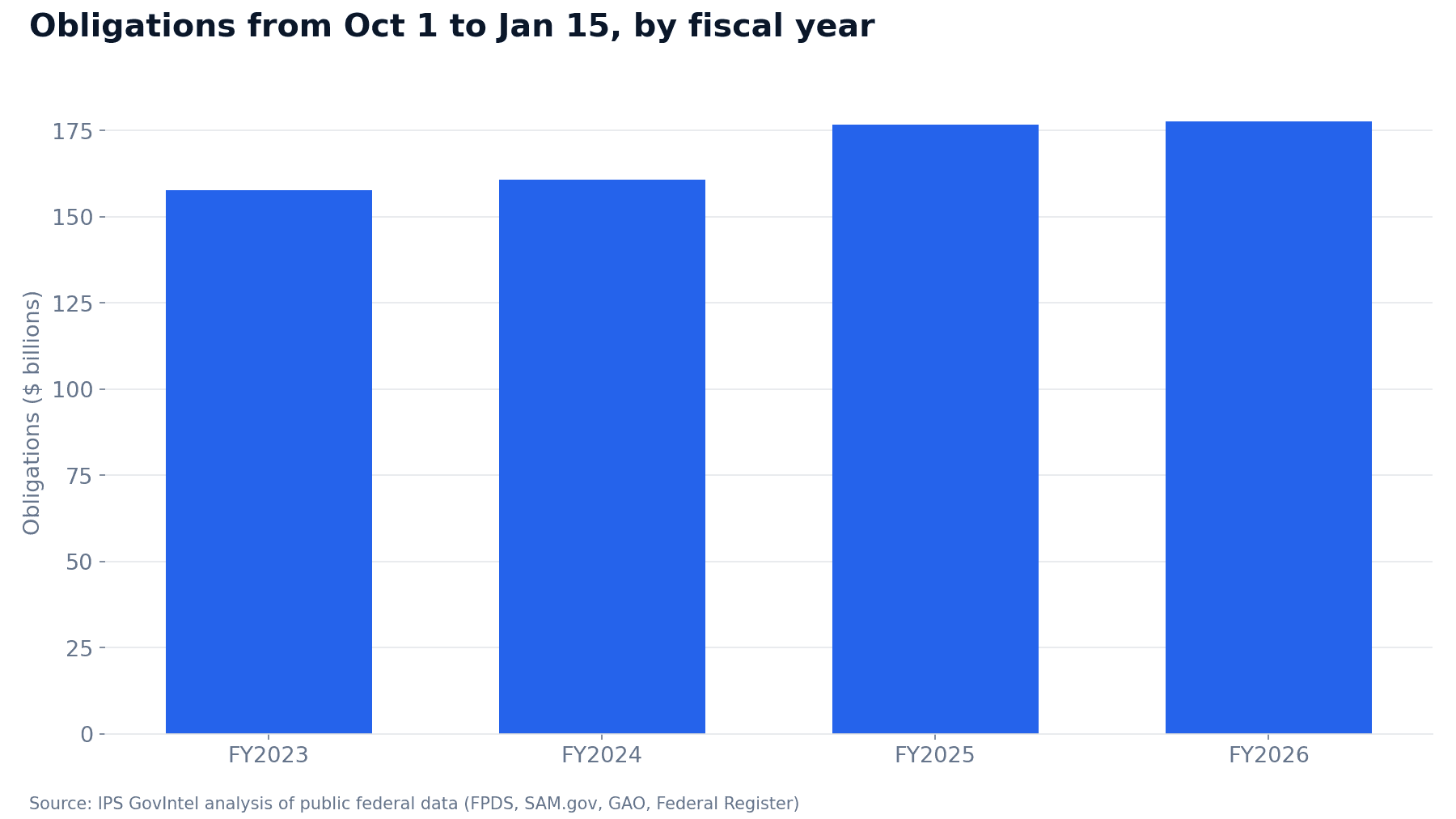
FY2026 obligated $177.7 billion in that window, essentially even with FY2025's $176.8 billion and ahead of FY2024 ($160.8 billion) and FY2023 ($157.8 billion). Getting there took fewer actions, though: 1,516,446, against 1,644,608 a year earlier.
The monthly path was unusual. October 2025 came in at just $22.7 billion, far below the $38 billion to $51 billion of the prior three Octobers. Then December 2025 hit $80.3 billion, the biggest December in the four years we looked at. So the dollars are on pace, but they're arriving in fewer, larger actions after a slow start. January 2026 is a partial month, and with the DoD lag those numbers will still move.
On the pipeline side, we looked at SAM.gov notices posted from April 2025 on. Combined synopsis/solicitations peaked at 15,775 in August 2025, and solicitations hit 10,392 that same month. Sources sought notices held between roughly 2,960 and 3,417 a month from April through July, then fell to 2,704 in August and 1,902 in September. Notice counts say what was posted, not what was awarded, so read them as a rough guide to timing.
What to do with this
- Find your customers' September share. If they look like DHS, SSA or State, build your capture calendar around July through September. Plan proposal staffing and leave accordingly.
- Answer sources sought now, not in August. Sources sought volume fell after July last year. If you want to shape a year-end requirement, April through July is the window.
- Have quick-turn pricing ready by July. Combined synopsis/solicitations peaked in August last year. Get your rate builds, past performance write-ups and reps & certs current before then.
- Plan cash for a slow October and November. Both months were among the four lowest in each of the last three years, and October 2025 was far below normal. Keep enough credit or reserves to carry you through Q1.
- Plan for a full-size Q4. Dollars from October through mid-January match last year, just spread across fewer actions. Nothing in that says year-end money is shrinking.
The money comes in September. Whether you're ready for it is decided between now and July.
Want this kind of read on your own pipeline or market? Get in touch.
Topics
Josh Parker
Founder of Indy-Pendent Solutions and flowState Software. Former Air Force combat rescue pilot, defense program manager, and capture strategist with 20+ years in defense acquisition.
Need help with your next capture?
Our software tools can help you win more government contracts.