Through February 19, agencies put $93.25 billion into new contract awards of $100,000 or more in FY2026. That's the highest of the five October-to-mid-February windows I checked. The part explicitly coded as a small-business set-aside was $4.82 billion, or 5.2%. That's the lowest share of the five years, back to FY2022.
So the total grew and the set-aside slice shrank, in dollars as well as in share.
The timing is useful. CRS published a new report on May 15, SBA's 8(a) Business Development Program: Structure and Current Issues, and SBA's Office of Hearings and Appeals is still putting out size appeal decisions every few weeks, including one on May 15 and another on May 19. With about four months left in FY2026, it's worth checking what each set-aside label actually carries, because "set-aside" isn't one pool of money. 8(a), SDVOSB, HUBZone and WOSB act like four separate markets.
Every number below comes from FPDS award data we track in GovIntel, our federal contracting data warehouse. Award data runs through February 19, 2026. DoD award data lags about 90 days, so the FY2026 figures will keep filling in, and DoD-heavy programs like 8(a) are likely to be understated.
💡 From the GovIntel desk this week
- 33 GAO protests were filed in the week to May 20, up from 31 the week before, across 10 agencies. Steady volume.
- 14 GAO decisions in the four weeks to May 20 were denied outright and 4 were dismissed. One each was sustained, sustained in part, and sustained on reconsideration.
- 370 SDVOSB set-aside notices posted this week, down from 433 the prior week. Total small business set-asides slipped to 2,611 from 2,758.
- $17.7 billion in DHS obligations from Oct 1, 2025 to Feb 19, 2026, versus $6.5 billion a year earlier. Data ends Feb 19.
- $140.5 billion in DoD obligations so far in FY2026 (to Feb 19) versus $150.6 billion a year earlier. DoD data lags about 90 days.
- $156.2 billion is the FY2027 request for defense-wide RDT&E, versus $42.8 billion in the prior request. Budget season signal for R&D-focused firms.
Data as of May 20, 2026, from IPS GovIntel: federal awards, opportunities, protests, rules and budgets, updated daily.
The like-for-like trend
To keep a partial year comparable, I looked at the same window every year: October 1 to February 19, new awards of $100K or more. Here is the share of base-award dollars carrying any set-aside code:
- FY2022: 6.0% ($4.2 billion)
- FY2023: 7.0% ($5.18 billion)
- FY2024: 7.5% ($5.48 billion)
- FY2025: 6.5% ($5.36 billion)
- FY2026 YTD: 5.2% ($4.82 billion)
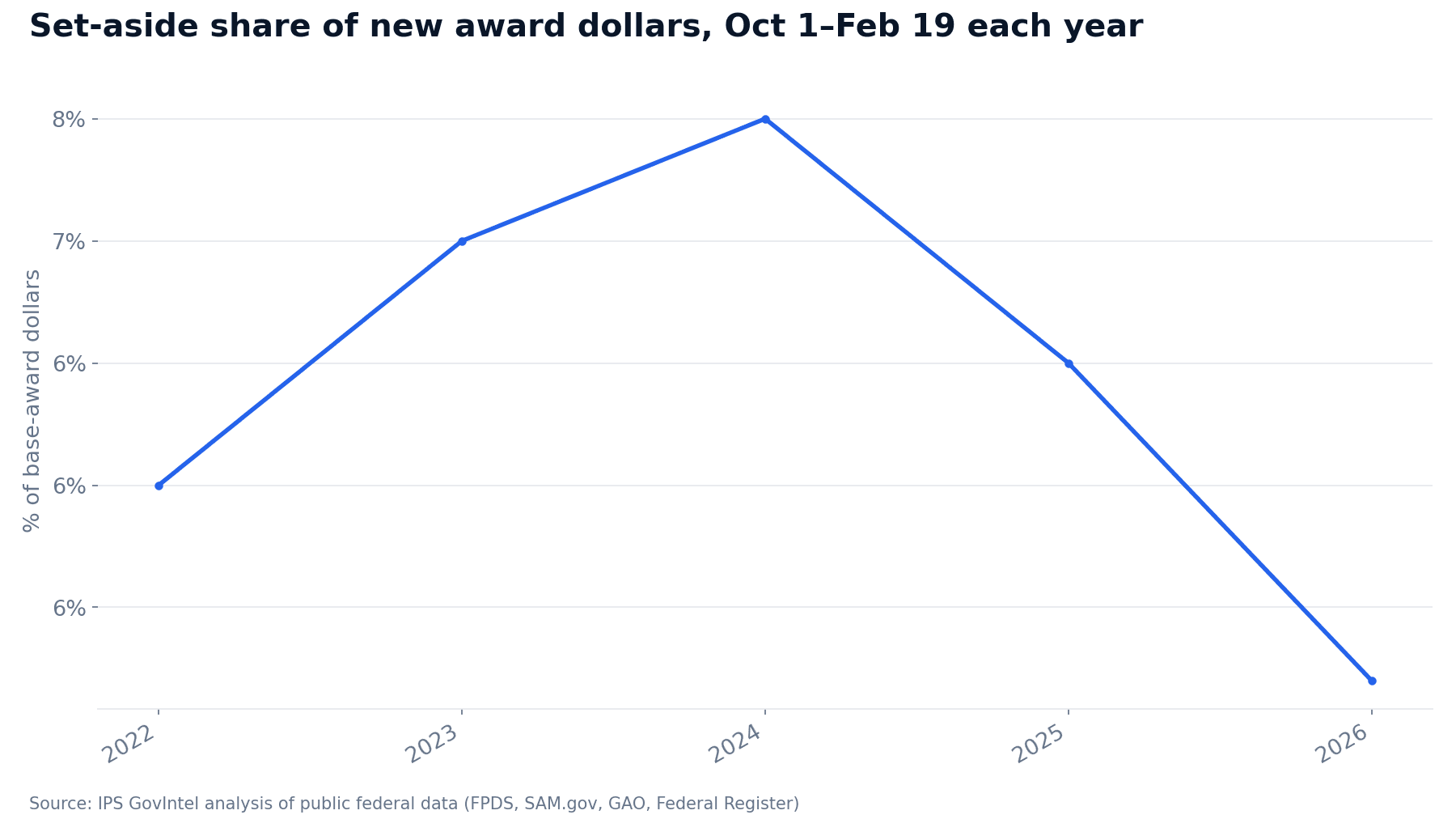
There's a caveat that matters. A large part of the denominator has a blank set-aside field. In the FY2025 window that was $62.5 billion of the $82.0 billion total. Many of those may be orders under vehicles where the set-aside is recorded on the parent contract, but the data can't tell us. So 5.2% is not the real small-business share. What I'd trust is the direction, and it has been down two years running.
The workhorse is still the plain total small business set-aside. In this window it went from $2.3 billion (FY2022) to $3.0 billion (FY2023), $3.37 billion (FY2024) and $3.35 billion (FY2025). Every socioeconomic program is a fraction of that.
8(a): mostly sole source, mostly DoD
In the same Oct–Feb window, 8(a) sole-source awards came to $595.5 million in FY2022, $781.8 million in FY2023, $719.9 million in FY2024 and $733.3 million in FY2025. Competed 8(a) was much smaller: $85.4 million, $161.8 million and $92.4 million for FY2022 through FY2024.
Widen the view to all 8(a) base awards from October 2024 through February 19, 2026, and the pattern holds. $3.9 billion was coded "not available for competition," against $779 million competed after exclusion of sources. 4,551 of those 8(a) base awards drew a single offer. 566 drew ten or more.
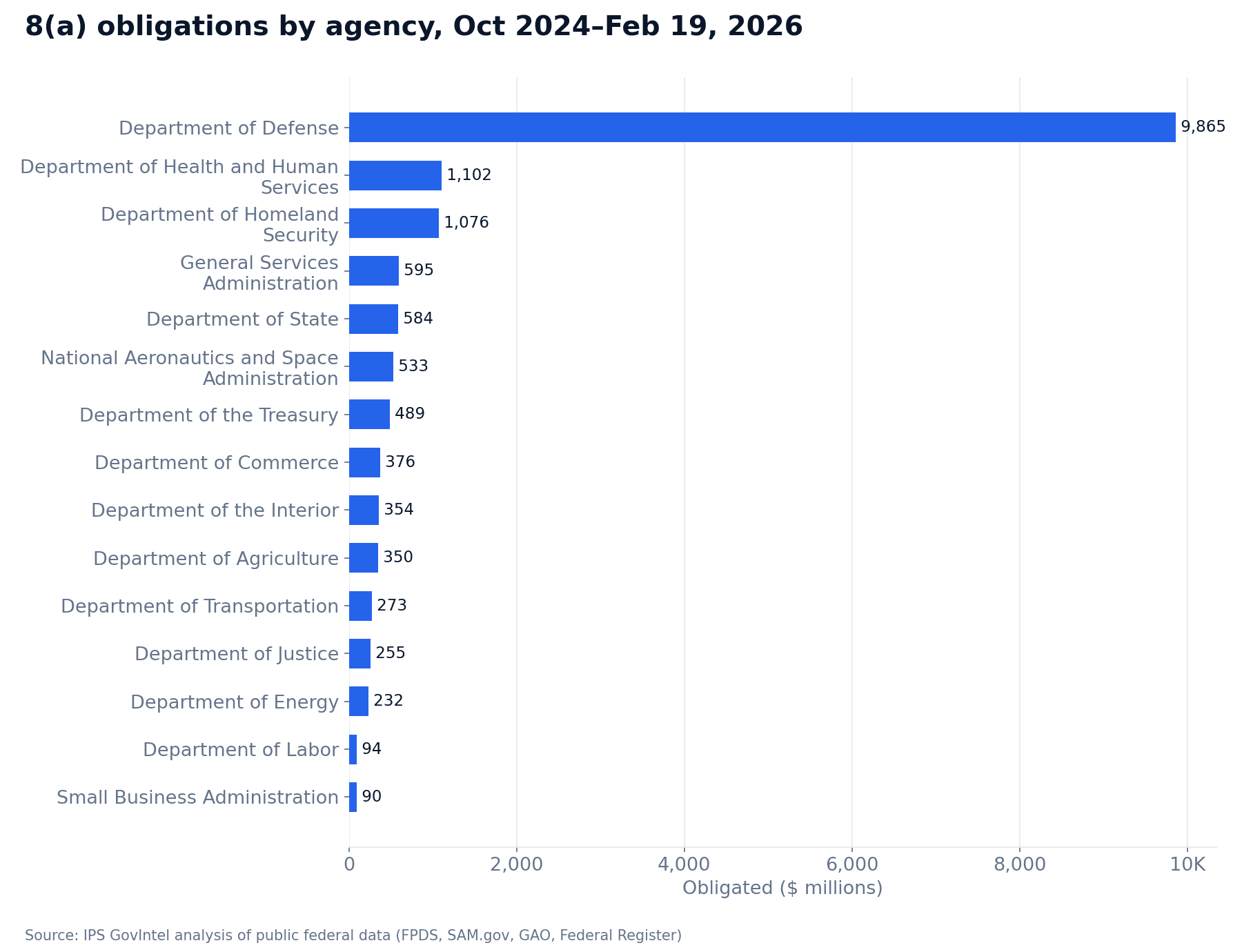
The buyers are concentrated too. Counting all 8(a) obligations over that period, modifications on existing contracts included, DoD obligated $9.9 billion. That's more than the other fourteen agencies in the top 15 combined. After DoD came HHS ($1.1 billion), DHS ($1.08 billion), GSA ($595 million across 8,731 actions), State ($585 million) and NASA ($533 million).
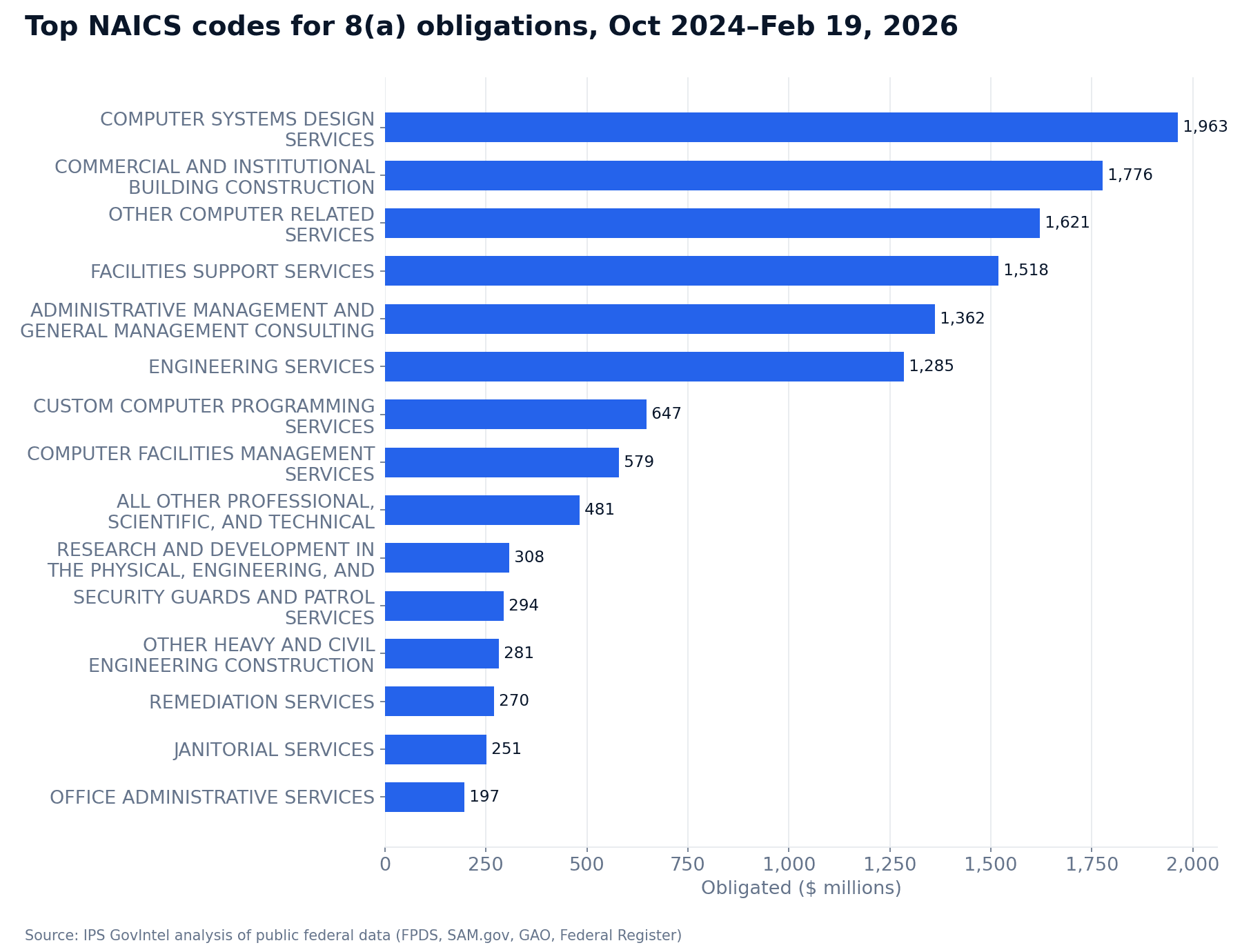
The work is mostly IT, construction and facilities. Computer systems design (541512) led at $1.96 billion, then commercial building construction (236220) at $1.78 billion, other computer-related services (541519) at $1.62 billion, facilities support (561210) at $1.52 billion, management consulting (541611) at $1.36 billion and engineering services (541330) at $1.29 billion.
My read: 8(a) is a relationship market. If you're in the program, most of the money moves through awards coded as not available for competition, and DoD is the biggest buyer even with the lag. If you're not, 8(a)-coded work in your NAICS isn't something you can bid on directly.
SDVOSB is mostly a VA program. HUBZone and WOSB are small and competed.
Across the FY2025 and FY2026 Oct–Feb windows combined, SDVOSB set-asides totaled $1.6 billion on 2,271 awards. The Department of Veterans Affairs accounted for $1.42 billion of that on 1,526 awards. DoD was a distant second at $125.1 million on 592 awards. Government-wide in name, VA-driven in practice. These awards are competed, too: 15.6% of SDVOSB set-aside awards drew a single offer. (That figure covers all agencies, not just VA.)
HUBZone is small. HUBZone set-asides were $69.4 million in the FY2022 window, $72.5 million in FY2023 and $41.8 million in FY2024. Across the FY2025–FY2026 windows they came to $161.2 million on 207 awards, with 18.4% single-offer. DoD ($61.7 million), DHS ($35.4 million) and USDA ($25.5 million) were the top buyers.
WOSB has grown but is still small: $36.4 million in the FY2022 window, $64.1 million in FY2023, $67.7 million in FY2024. The FY2025–FY2026 windows held $104.1 million on 398 awards, and only 7.0% were single-offer. Among all WOSB-coded base awards since October 2024, 917 drew ten or more offers and 380 drew one.
For comparison, total small business set-asides were single-offer 13.5% of the time. Awards coded "no set aside used" were single-offer 56.7% of the time.
So outside 8(a) sole source and VA's SDVOSB buying, a certification doesn't get you a quiet market. You get a smaller pool of money, and most of it is competed.
What to do with this
- Run your own cut. Break down your target agencies and NAICS codes by set-aside code, using the same Oct–Feb window for each year. A program can be growing government-wide and shrinking in your agencies.
- SDVOSB firms: start with VA. Outside VA, SDVOSB set-aside dollars thin out quickly. Plan the rest of your pipeline knowing that.
- 8(a) firms: map the sole-source buyers in your codes. DoD, HHS and DHS lead. DoD data lags about 90 days, so check again in late summer before you write anything off.
- HUBZone and WOSB firms: price for competition. Most of these awards draw several offers. Don't count on the set-aside to keep prices up.
- Don't rely on the headline share. A blank set-aside field may mean the code sits on the parent vehicle. Check the vehicle before you decide an agency doesn't set work aside.
The set-aside label tells you who's allowed to bid. The data tells you whether there's enough money there to make it worth bidding.
Want this kind of read on your own pipeline or market? Get in touch.
Topics
Josh Parker
Founder of Indy-Pendent Solutions and flowState Software. Former Air Force combat rescue pilot, defense program manager, and capture strategist with 20+ years in defense acquisition.
Need help with your next capture?
Our software tools can help you win more government contracts.