Only 12.5% of the Sources Sought notices posted from May through October 2025 were later followed by a solicitation with the same solicitation number. That's 1,520 out of 12,196.
Treat that as a floor. We matched on exact solicitation number, so a requirement that was renumbered between market research and the RFP doesn't count, and we can't see from the data how many that is. Still, the point stands. A Sources Sought is the government asking a question. It doesn't promise a contract.
That matters right now. It's early May, seven months into FY2026 and about four months out from the September buying surge. Market research posted this spring feeds the Q4 solicitation wave. We track the full notice stream in GovIntel, our federal contracting data warehouse, so here's what it says about the 12 months to May 6, 2026.
💡 From the GovIntel desk this week
- $135.6 billion in DoD obligations from Oct 1, 2025 to Feb 5, 2026, the most of any agency. DoD award data lags about 90 days.
- $26.9 billion obligated by Veterans Affairs in the same FY2026 window, second behind DoD and ahead of DHS at $16.1 billion.
- 16 of 22 GAO decisions in the 30 days to May 6 were denials. Four were dismissed, one was denied in part and dismissed in part, and one was sustained in part and denied in part. None was sustained in full.
- 40 GAO protests filed in the week ending May 6, up from 29 the week before. One week is a small sample, so don't read a trend into it.
- EO 14402, "Promoting Efficiency, Accountability, and Performance in Federal Contracting," was issued May 5. Watch for how it changes solicitation and performance requirements.
- M-26-12 implementation guidance on buying more commercial products and services was issued by DoD on May 1. It may shape how upcoming buys are structured.
Data as of May 6, 2026, from IPS GovIntel: federal awards, opportunities, protests, rules and budgets, updated daily.
The set-aside door is mostly one door
Agencies posted solicitations and combined synopsis/solicitations over those 12 months. Of those, 41.6% (94,411 notices) were total small business set-asides. That's almost exactly the share with the set-aside field left blank: 94,802 notices, or 41.8%. Another 7.1% were explicitly coded "No set aside used."
The socioeconomic programs are much thinner slices of the notice count:
- SDVOSB set-aside: 12,172 notices (5.4%)
- WOSB set-aside: 3,106 (1.4%)
- HUBZone set-aside: 2,046 (0.9%)
- Competitive 8(a): 1,392 (0.6%)
If your capture plan assumes a steady supply of competitive 8(a) or HUBZone solicitations on SAM.gov, check that assumption against the volume. The total small business set-aside is where most of the small business notices are.
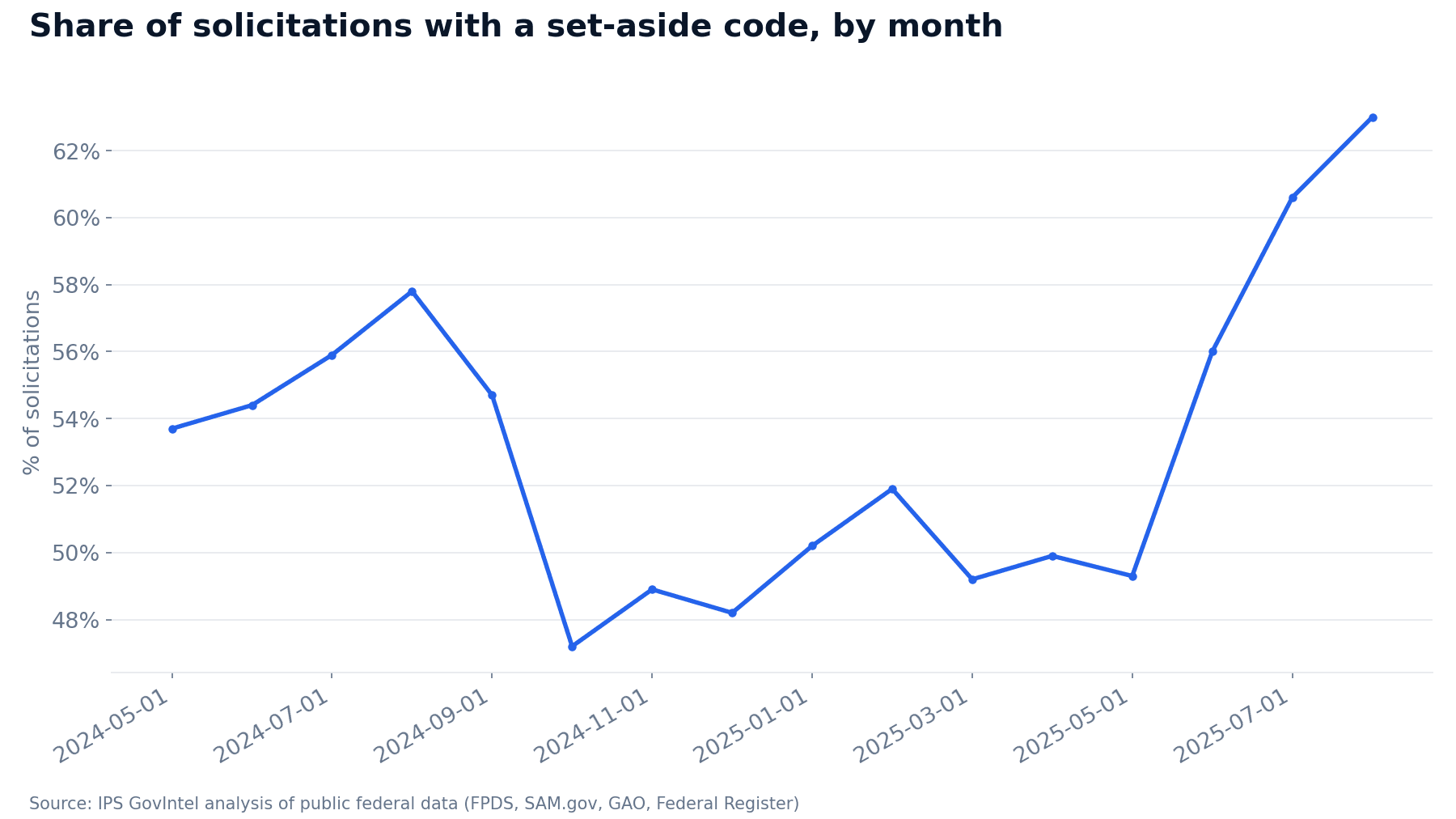
Now the trend. Our monthly measure counts any solicitation whose set-aside field is filled in, and that includes the "No set aside used" code. Read it as directional. Even so, every full month of FY2026 so far is above the same month a year earlier: October 52.4% vs. 47.2%, January 58.3% vs. 50.2%, March 58.7% vs. 49.2%. April 2026 came in at 63.8%, against 49.9% in April 2025, the highest month in our two-year window.
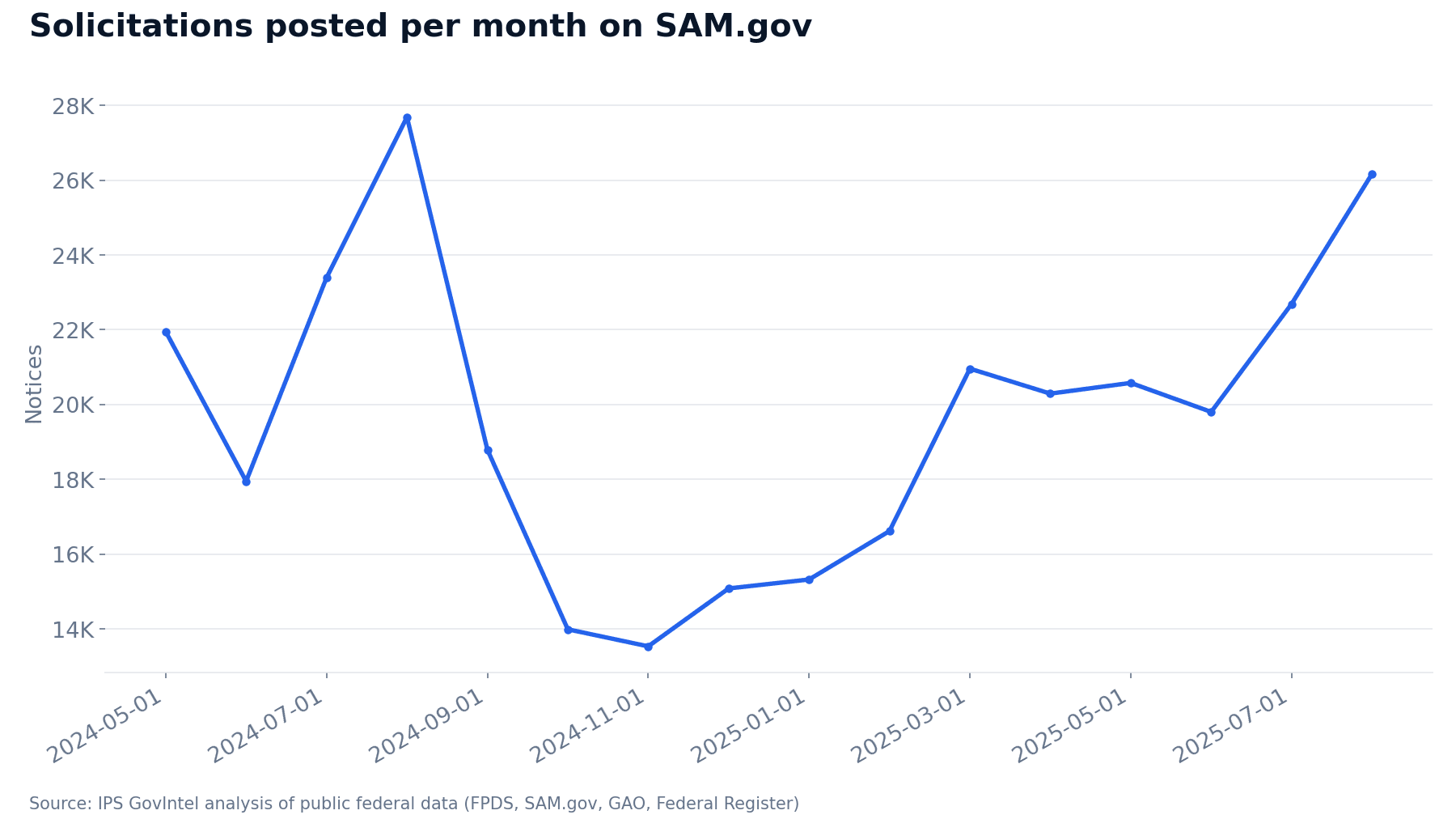
Volume has a seasonal pattern too. August was the biggest month in both summers: 27,684 solicitations in August 2024 and 26,167 in August 2025. October 2025 dropped to 13,737. If you want to be ready for August, start reading the stream now.
Which agencies lean on set-asides
Same caveat as above: "set-aside" here means the field carries any code.
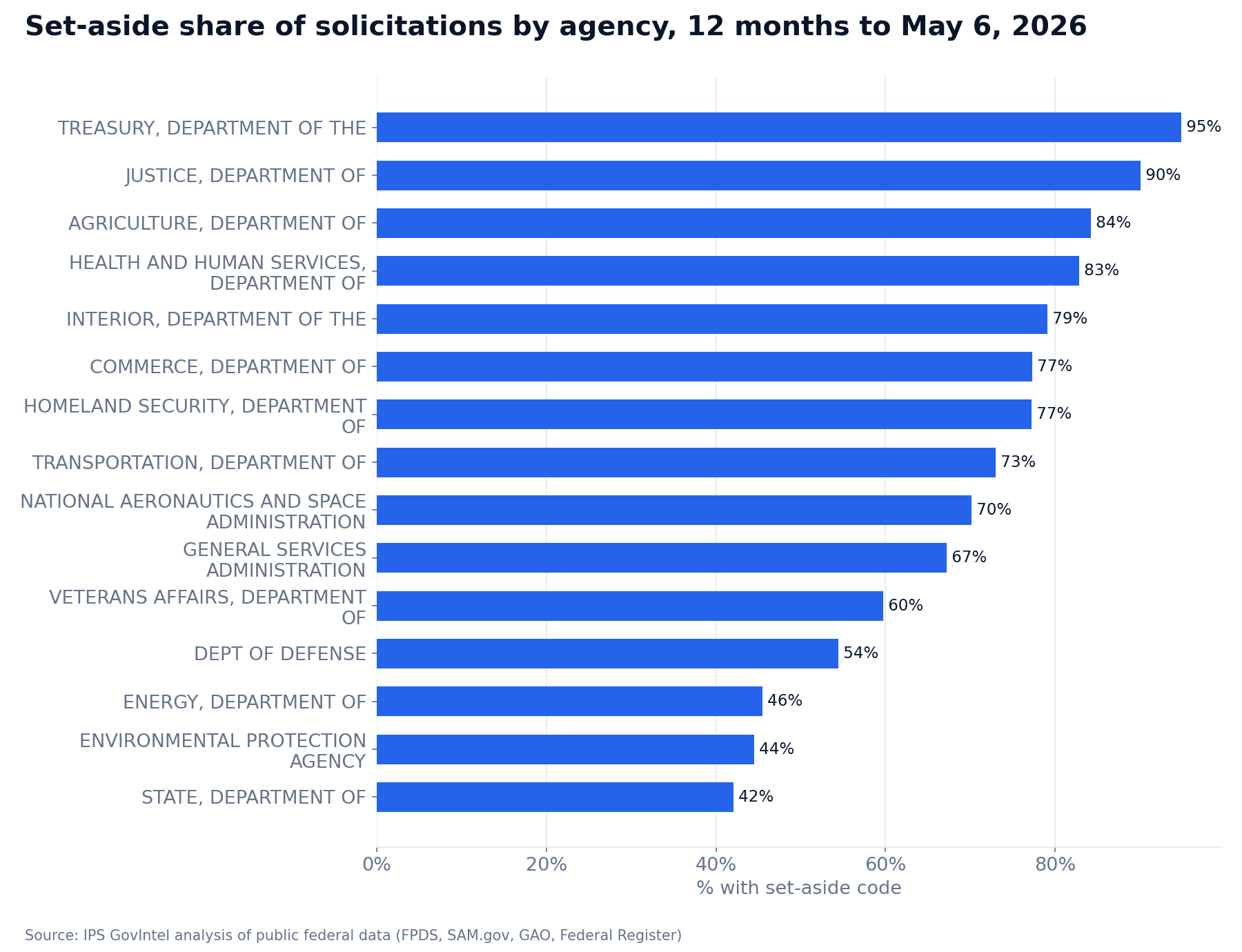
Treasury posted 350 solicitations with a 94.9% set-aside share. Justice posted 3,398 at 90.1%, Agriculture 6,143 at 84.2%, and HHS 2,752 at 82.8%. Interior (8,504 at 79.1%) and DHS (6,981 at 77.2%) combine real volume with a high share.
The Department of Defense is the opposite case. It posted 169,045 solicitations, far more than anyone else, at a 54.4% share. That's still the largest pool of set-aside notices by count, but you'll sift through a lot more unrestricted notices to find them. VA came in at 59.7% on 15,591. State (42.1%), Energy (45.5%) and EPA (44.5%) sit at the bottom of the list.
If you're a small firm picking two or three civilian agencies to learn well, the ones with high set-aside shares are a reasonable place to start.
How many days you actually get
This is the part that should change how you staff proposals. We measured the time from posting to response due for the past 12 months, excluding notices with no usable due date or one more than a year out.
For formal solicitations, the median response window on notices carrying a set-aside code was 12.9 days. On notices without one it was 18.9 days. A quarter of set-aside solicitations gave 6.8 days or less (vs. 9.1 days), and three-quarters closed within 22.3 days (vs. 30.5).
Combined synopsis/solicitations, which tend to be commercial and simplified buys, look the same either way: a 10.8-day median, with the middle half falling between roughly 7 and 14 days.
So the set-aside solicitations in this stream come with short clocks. A two-week median doesn't leave time to write from scratch. If you first see a requirement when the RFP drops, you're writing it in about 13 days, and a quarter of the time you have under a week.
Do the dollars match the notices?
Not yet. Contract action data for FY2026 through February 5, compared with the same window of FY2025, runs the opposite way from the notice stream:
- Total small business set-aside: $7.23 billion vs. $8.04 billion (36,008 actions vs. 39,594)
- 8(a) sole source: $1.80 billion vs. $2.08 billion
- Competitive 8(a): $0.83 billion vs. $1.14 billion
- WOSB set-aside: $0.18 billion vs. $0.28 billion
- SDVOSB set-aside: up, to $2.03 billion from $1.74 billion
Unrestricted dollars held roughly flat. Actions with no set-aside code came to $119.26 billion vs. $118.39 billion, and actions coded "No set aside used" came to $97.93 billion vs. $100.49 billion.
The data can't settle this yet, for three reasons. DoD award data lags about 90 days, so the FY2026 window ends February 5 and may be undercounted. Obligations include modifications and orders on older vehicles, not only new awards. And today's notices become later obligations. Notices lead and dollars lag. Whether the higher set-aside share in the notices shows up in dollars is something to watch, not assume.
One more data point. Justification (sole-source) notices peaked in September in both years we can see: 895 in 2024 and 874 in 2025. April 2026 had 506, about in line with April 2025's 533. No sign yet of a jump in sole-source work moving out of open competition.
What to do with this
- Answer Sources Sought selectively. With roughly 1 in 8 traceable to a same-number solicitation, put your effort into the ones where you can shape the acquisition strategy or the set-aside decision. Don't treat each one as a pipeline entry.
- Track renumbered requirements by hand. Your real conversion rate may be higher than 12.5%, but only if you follow requirements to a new solicitation number. Log the agency, office and scope, not just the number.
- Get your proposal content ready before August. A 12.9-day median and a 6.8-day bottom quartile on set-aside solicitations mean past performance write-ups, resumes and pricing models need to be done before the RFP drops.
- Weight your agency targets by set-aside share, not just volume. Justice, Agriculture, HHS, Interior and DHS combine meaningful volume with set-aside shares above 75%.
- Watch the FY2026 dollars against the notices. If small business set-aside obligations are still behind last year once the DoD lag clears, ask the agency small business office why.
The notice stream shows you what's coming, so start reading it before the September rush.
Want this kind of read on your own pipeline or market? Get in touch.
Topics
Josh Parker
Founder of Indy-Pendent Solutions and flowState Software. Former Air Force combat rescue pilot, defense program manager, and capture strategist with 20+ years in defense acquisition.
Need help with your next capture?
Our software tools can help you win more government contracts.