One research line in the FY2027 DoD request, the Defense Autonomous Warfare Group, goes from $225.9 million in the current-year column to a $54.6 billion request.
That's one line. It isn't an agency or a portfolio. Whatever you make of it, it tells you something solicitations won't tell you for a long time: where the Department says it wants the money to go.
It's late May, and FY2027 starts October 1. Most small contractors won't open a J-book until a sources sought notice shows up. By then the shape of the requirement is mostly set. The budget books get there first.
💡 From the GovIntel desk this week
- $9.69 billion sole-source Microsoft licensing agreement (ESA II BPA) went to Dell Federal Systems on May 27, announced by Naval Information Warfare Center Pacific.
- $763 million to small business Casual Performance Inc. for DLA fitness gear on May 22, so small firms do win very large commodity awards.
- $452.9 million ceiling each for at least five vendors on a Navy network-systems IDIQ announced May 21; multiple-award vehicles can mean teaming and subcontract openings.
- 50 of the active solicitations posted May 21-27 on SAM.gov were total small business set-asides, alongside 13 SDVOSB and 7 8(a) notices.
- 2 of 24 GAO protest decisions from Apr 28 to May 27 were sustained (one with its remedy modified on reconsideration); 15 were denied outright.
- $10.5 billion in Energy Department obligations in the 30 days to Feb 26, versus $1.2 billion the prior 30. FY2026 data, lagged about 90 days.
Data as of May 27, 2026, from IPS GovIntel: federal awards, opportunities, protests, rules and budgets, updated daily.
The top line: everything goes up, procurement most of all
We track the justification books in GovIntel, our federal contracting data warehouse. This piece compares the FY2027 President's Budget request with the FY2026 current-year column, summing the R-1, P-1 and O-1 exhibits:
- Procurement: $223.8 billion current year, $413.1 billion requested (+69.8%)
- RDT&E: $213.1 billion current year, $344.8 billion requested (+60.8%)
- O&M: $355.1 billion current year, $430.8 billion requested (+21.2%)
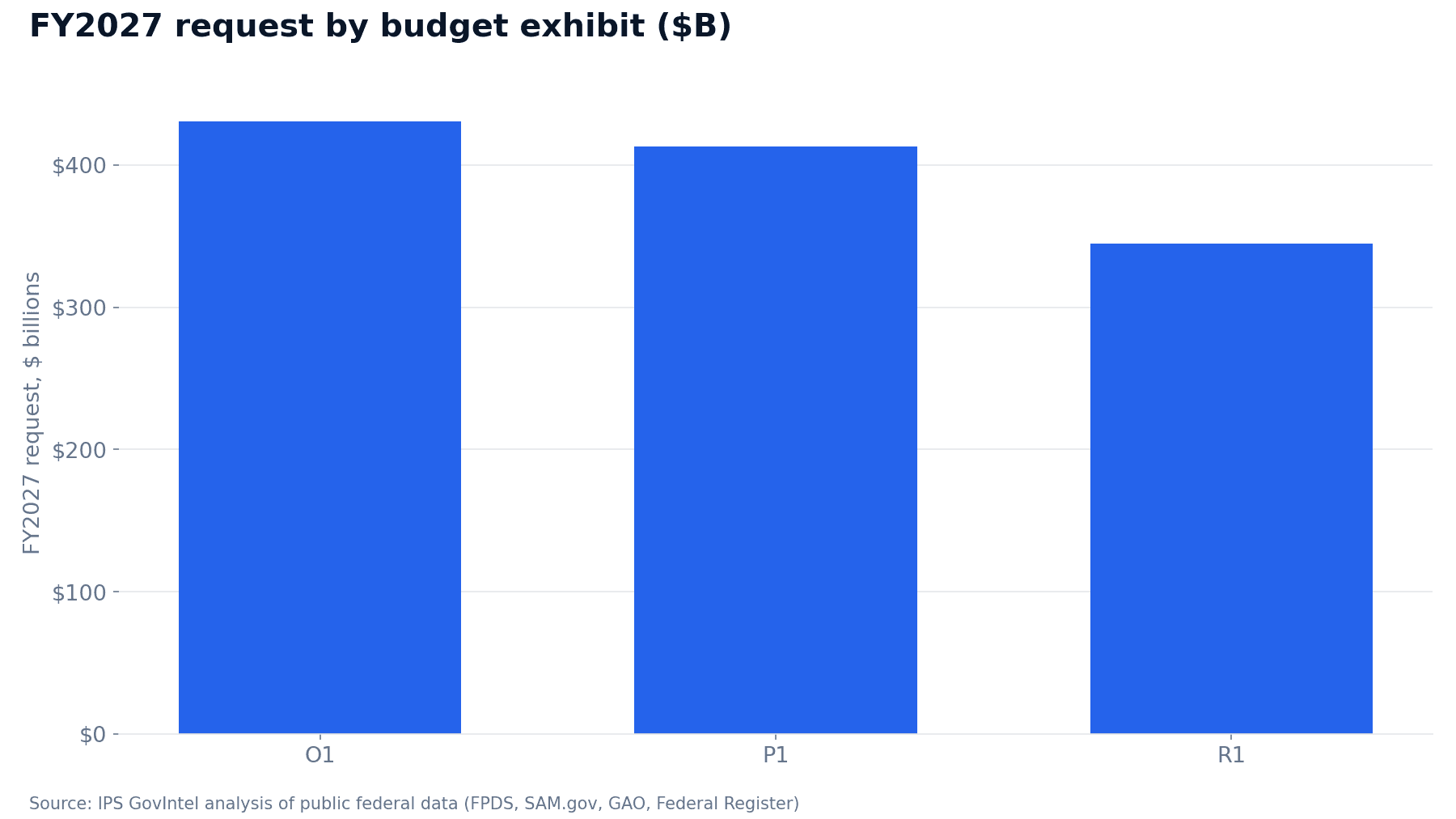
Before you rebuild your pipeline around those numbers, remember the obvious: a request is a request. Last year's book requested $205.2 billion in procurement for FY2026. This year's book shows FY2026 current-year procurement at $223.8 billion. In that case the current-year number ended up higher than the request. Plan around the direction of the change. The exact dollar figure is the least reliable part.
Where the money actually moves
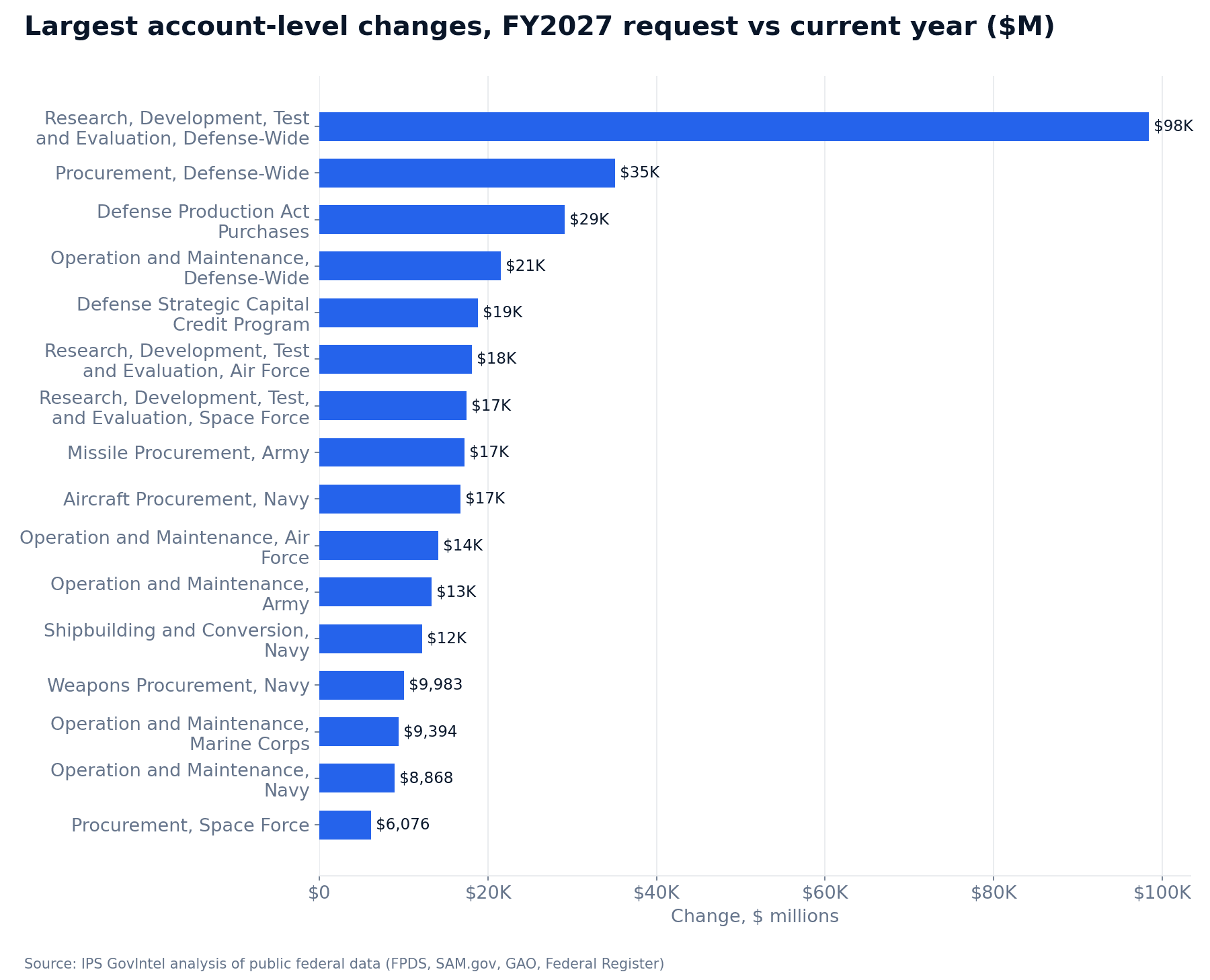
The account-level view is more useful than the top line, and some of it is surprising.
Defense-wide accounts carry the biggest increases. RDT&E, Defense-Wide goes from $58.6 billion to $156.2 billion. Procurement, Defense-Wide goes from $11.5 billion to $49.7 billion. Within those, Industrial Base Analysis and Sustainment Support rises from $11.3 billion to $41.8 billion.
A lot of the growth isn't a traditional contract. Defense Production Act Purchases go from $1.3 billion to $30.4 billion. The Office of Strategic Capital Loan Program goes from $1.4 billion to $20.2 billion. The second one is, by its name, a loan program. Some of this money may reach companies through financing and industrial-base instruments, not a services task order on SAM.gov. Read the justification text before you count it as addressable.
The services' own accounts grow too. Air Force RDT&E rises from $57.0 billion to $74.2 billion. Space Force RDT&E roughly doubles, from $20.3 billion to $40.7 billion. Army Missile Procurement goes from $8.0 billion to $36.6 billion, and Navy Aircraft Procurement from $17.7 billion to $34.4 billion.
For most small businesses, the most interesting lines are the ordinary ones:
- Army Facilities Sustainment, Restoration & Modernization: $6.7 billion to $14.5 billion
- Air Force FSRM: $5.7 billion to $11.5 billion
- One Navy sustainment, restoration and modernization line: $2.4 billion to $9.2 billion
- The DISA O&M line: $3.0 billion to $16.3 billion
- O&M, Marine Corps: $12.2 billion to $21.6 billion
Money in O&M accounts like these is often spent through base-level contracting offices, set-asides and IDIQ task orders. If you do facilities, IT operations or sustainment work, those lines are more relevant to you than a submarine program.
Where it shrinks, and how to read a cut
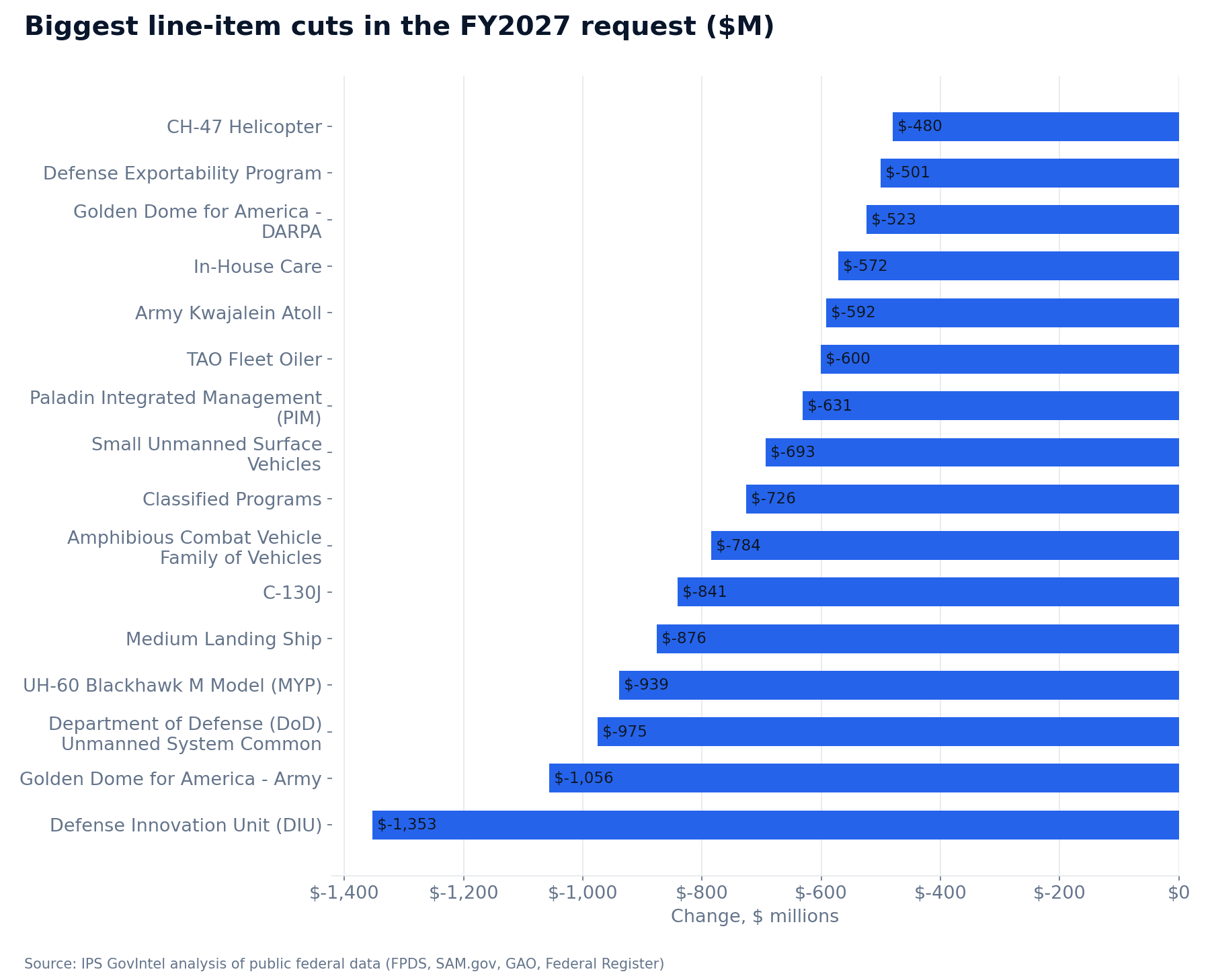
Cuts get less attention, but they're just as useful. They tell you where you shouldn't build new capability.
A few stand out:
- Golden Dome for America – Space Programs: $10.8 billion to $4.5 billion. The overall Golden Dome fund account drops 16.9%, from $21.1 billion to $17.5 billion, while the MDA Golden Dome line rises from $4.0 billion to $7.2 billion. The money is being shuffled between lines, not simply going away.
- Medium Unmanned Surface Vehicles: $1.95 billion to $171.1 million. Small Unmanned Surface Vehicles: $694.0 million to $0.6 million. DoD Unmanned System Common Development: $1.0 billion to $36.7 million.
- Defense Innovation Unit: $1.9 billion to $522.6 million. Defense-Wide Manufacturing Science and Technology: $2.0 billion to $581.8 million.
- DHA Medical Development: $1.76 billion to $360.8 million.
Put the unmanned cuts next to the autonomous warfare line from the top of this piece and one reading is that autonomy money is being consolidated, not abandoned. The numbers alone can't confirm that. If you've been selling into the smaller unmanned lines, it's worth finding out whether the customer is changing even though the mission isn't.
Two cautions. First, a one-year drop in a procurement line can come from contract structure (multiyear buys, full funding taken in a prior year) and doesn't necessarily mean the program is dying. B-21 procurement ($7.3 billion to $3.2 billion) and DDG-51 ($7.3 billion to $3.3 billion) are examples where you should read the P-40 narrative before drawing conclusions. Second, Congress puts money back all the time. A cut in the request tells you what the Department wants. It doesn't tell you what will be enacted.
What this data can't show you
This piece compares requests against the current year at the line and account level. It does not cover the planned contract detail inside the books: contract method, competition type and planned award dates. That detail typically sits in the R-3 cost analysis and P-5A procurement history exhibits for each program, and it's the most actionable part of a J-book for capture. You'll have to open the PDFs for the lines you care about. It's tedious, but it's an early public signal of when an award is supposed to happen and how it may be competed.
These figures also cover only the R-1, P-1 and O-1 lines in the loaded books. Classified lines show up as dollars with no description and are included in the totals. It isn't every dollar DoD spends.
What to do with this
- Pull the lines that match your NAICS work, not the headline programs. Facilities sustainment, DISA operations and Marine Corps O&M are where requested growth meets small-business-sized contracts.
- Open the R-3 and P-5A exhibits for those lines and write down the contract method and planned award dates. Put those dates on your pipeline calendar now.
- Separate financing from contracting. DPA purchases and strategic capital loans are big numbers, but much of that money may not arrive as a solicitation.
- Check how exposed you are to the cuts. If revenue depends on a line that's down 70% or more in the request, start talking to the customer now about where that work is moving.
- Track the markups. When the House and Senate marks come out, compare them against these lines. Agreement between the request and both marks is the strongest signal you'll get before the RFP.
The budget books aren't exciting reading, but they show you where the demand is going before the solicitations do.
Want this kind of read on your own pipeline or market? Get in touch.
Topics
Josh Parker
Founder of Indy-Pendent Solutions and flowState Software. Former Air Force combat rescue pilot, defense program manager, and capture strategist with 20+ years in defense acquisition.
Need help with your next capture?
Our software tools can help you win more government contracts.