In the 12 months to June 24, 2026, GAO decided 833 bid protests where we have both a filing and a decision date. Of those, 432 closed within 30 days of filing. Just four took 101 to 120 days, and one took 121.
Most contractors treat a protest like a lightning strike: random, unforecastable, somebody else's problem until it lands on them. The numbers say it's more orderly than that. You can see when protests tend to get filed, how long GAO tends to take, and how they usually end.
The federal fiscal year's fourth quarter starts next week. Awards made in July, August and September will run into those protest clocks, and some of those clocks won't stop until the new fiscal year is underway. I'd rather you put the clock on your schedule now than discover it in October.
We track this in GovIntel, our federal contracting data warehouse, which links protest dockets, published GAO decisions and contract award records. Here's what it shows.
💡 From the GovIntel desk this week
- $29.7 billion in DHS obligations, Oct 2025–Mar 2026, versus $8.2 billion a year earlier (+262%); a big shift in civilian spending. Award data lags about 90 days.
- 4 of the 10 largest March 2026 awards were CBP construction contracts worth roughly $1 billion each, competed after excluding some sources.
- 3,984 solicitations posted this week, down 28% from 5,508 the prior week: a quieter stretch for new bid opportunities.
- 1,709 small-business set-aside notices (solicitations, presolicitations, sources sought) this week, with 301 more reserved for service-disabled veteran-owned firms.
- $41.8 billion requested for FY2027 Industrial Base Analysis and Sustainment, up from $2.3 billion; it is a request, not enacted funding.
- $3.2 billion obligated to Electric Boat on 16 March 2026 without competition, the largest March action; potential value $42.2 billion. Award data lags about 90 days.
Data as of June 24, 2026, from IPS GovIntel: federal awards, opportunities, protests, rules and budgets, updated daily.
Clock one: when protests get filed
We matched protests to their underlying awards by solicitation number, for protests filed in the 24 months to June 24, 2026. Two caveats up front. Our protest filing dates start in November 2025, so in practice this is roughly eight months of filings, not 24. And award records only run through March 26, 2026, because DoD award data lags about 90 days. Recent protests can't be matched to recent awards, so the most recent filings are underrepresented.
With that said, 303 protests matched, and the front end of the curve is steep:
- 19 were filed within 5 days of award
- 61 were filed in days 6–10
- 33 were filed in days 11–14
- 50 were filed in days 15–30
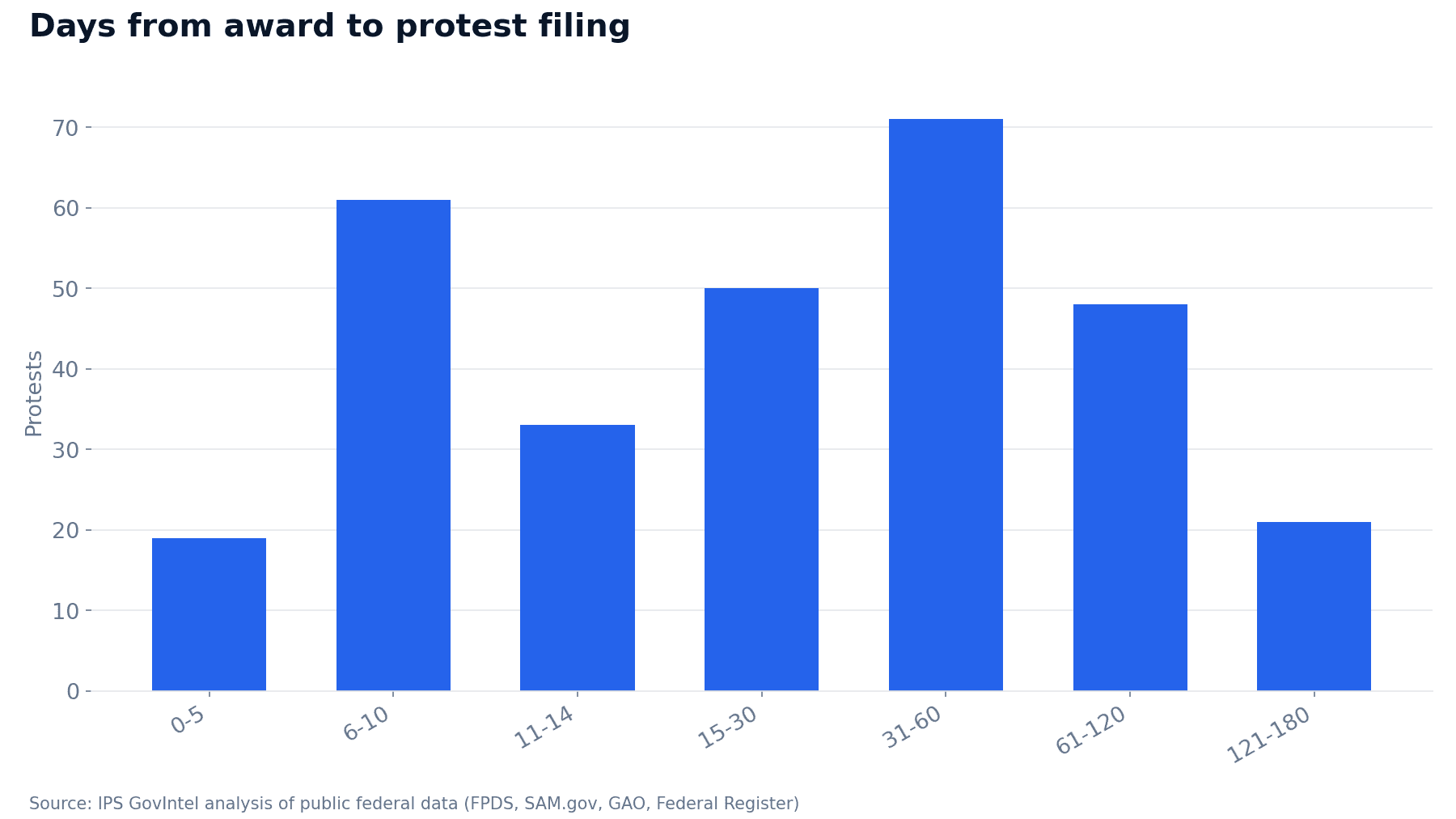
The days 6–10 bump likely reflects the CICA stay. A GAO protest filed within 10 days of award (or within 5 days after a required debriefing) triggers an automatic stay of performance. That's the deadline protesters race to beat. In all, 80 of the 303 came in within 10 days.
There's also a long tail: 71 filed in days 31–60, 48 in days 61–120, and 21 in days 121–180. Some of that is debriefing timing, some is later orders under the same solicitation, and some is the limit of matching by solicitation number. Treat the tail with caution.
Don't assume a small contract keeps you out of this. Among those matched protests, 62 involved awards with a potential value under $1 million, 51 were in the $1–5 million range and 56 were in the $5–25 million range. The $25–100 million band had the most at 84, and $100 million-plus had 50. Protests happen at every size.
Clock two: how fast GAO closes them
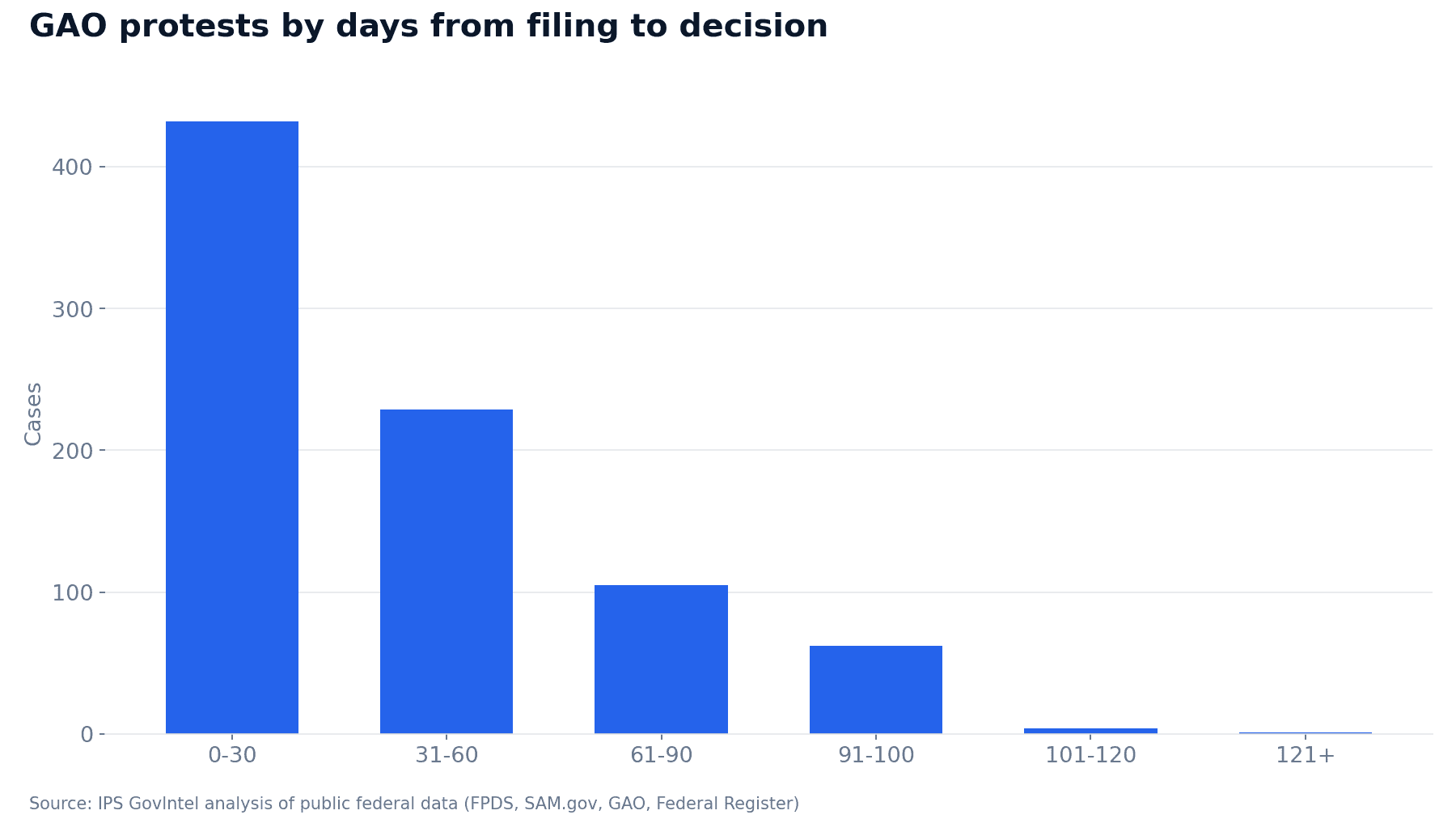
GAO has 100 days by statute to decide a protest. In practice it rarely needs all of them. Of the 833 GAO cases decided in the 12 months to June 24, 2026, 432 closed within 30 days and 229 within 31–60 days. Another 105 took 61–90 days, and 62 landed in the 91–100 window, right against the deadline.
How long it takes depends on how the case ends. Median days from filing to decision:
- Withdrawn: 19 days (94 cases)
- Dismissed: 26 days (551 cases)
- Denied: 74 days (178 cases)
- Sustained: 79.5 days (8 cases)
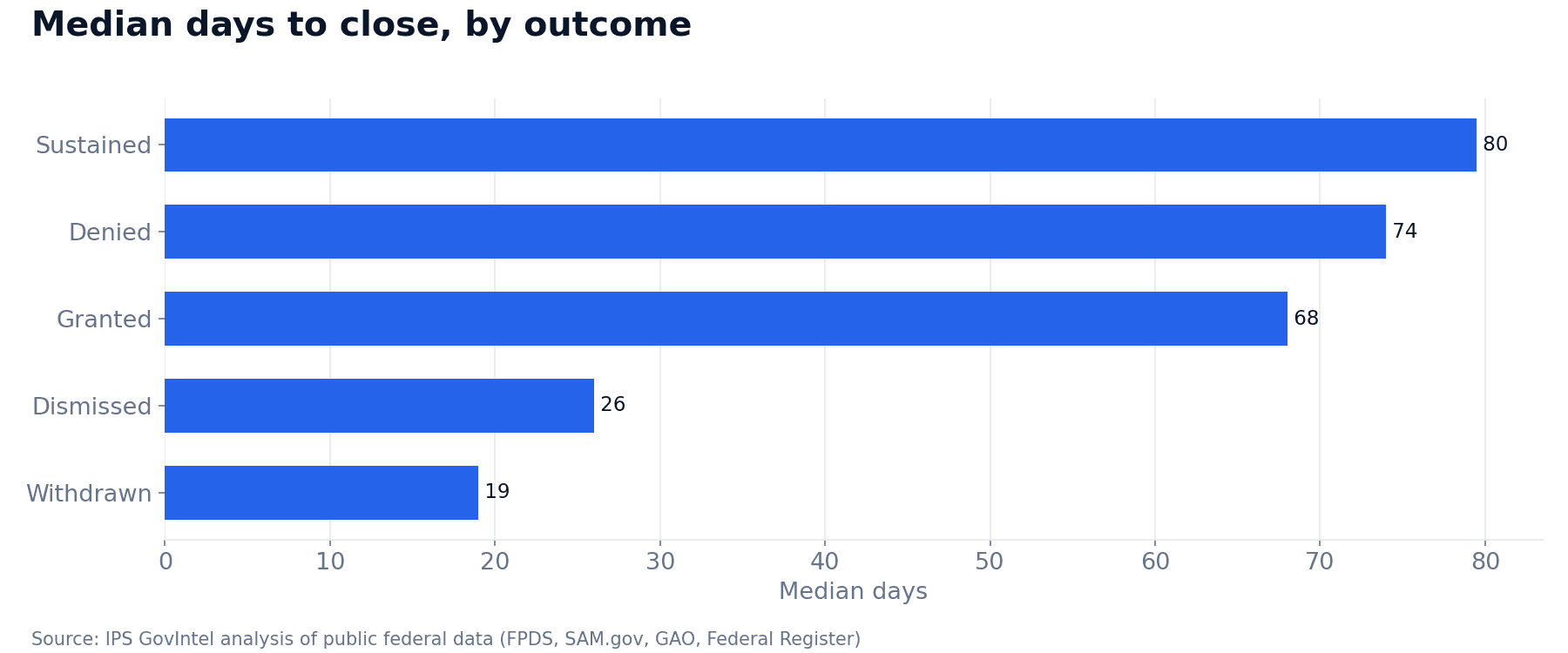
So there are two protest timelines. If a protest ends early, it's usually over in three or four weeks. If it goes to a merits decision, plan on about two and a half months. Both are predictable enough to put in a schedule.
Clock three: how protests end
Formal wins for protesters are rare. Across all forums, cases decided in the 12 months to June 24, 2026 broke down as 562 dismissed, 217 denied, 94 withdrawn, 11 granted and 8 sustained.
If you only look at sustains, protests look like a long shot. That reading is incomplete. A dismissal or withdrawal can follow agency corrective action, such as a re-evaluation or a new award decision. But the docket data doesn't record why a case was dismissed or withdrawn, so I can't give you a corrective-action rate from it. What I can say is that most cases end fast and without a merits ruling.
Published GAO decisions give a partial view. All 9 sustained decisions in the period carried a corrective-action flag, as did 16 of the 182 denials. Again, the flag tells you corrective action is part of the decision. It doesn't tell you the sequence.
By agency, among those with at least eight published decisions:
- Air Force: 32 decisions, 5 with corrective action, 2 sustained
- Defense Logistics Agency: 14 decisions, 4 with corrective action, 1 sustained
- VA: 33 decisions, 2 with corrective action, none sustained
- Army: 14 decisions, 2 with corrective action, none sustained
- Navy: 14 decisions, none with corrective action, none sustained
- GSA: 11 decisions, none with corrective action, none sustained
These are small samples, so don't build a strategy on one agency's line.
Volume tells you where the clocks start. In the 12 months to June 24, 2026, the Army had the most protests filed with 171, followed by VA (158), the Defense-wide bucket listed as Department of Defense (126), Air Force (106), Navy (94) and DHS (88). Monthly filings in our series ranged from 88 in January 2026 to 176 in November 2025. June had 127 through the 24th. With the series this short, I wouldn't read a trend into it.
What this means for Q4 awards
Here's the arithmetic. Take an award made in mid-September. A protest filed in days 6–10 triggers the stay. If it goes to a merits decision, the denied and sustained medians of 74 to 80 days put the answer around mid-December. At the full 100 days, it's early January. The contract you planned to start on October 1 now starts in the first or second quarter of FY2027, assuming it's still your contract.
That affects your hiring plan, your cash flow, your subcontractor commitments and your team's morale. It's easier to plan for in July than to explain in November.
What to do with this
- Treat the first 10 days after award as a live risk window. Also the first 5 days after a required debriefing. Don't make irreversible hiring or spending commitments until that window closes.
- Build two protest scenarios into every Q4 transition plan. Use a short one of about 3–4 weeks for the dismissal or withdrawal path, and a long one of about 75–100 days for a merits decision. Model cash flow under both.
- Keep offer letters and subcontract start dates flexible. Tie them to notice to proceed, not award date.
- Handle debriefings promptly, whether you won or lost. Debriefing timing affects the stay window, and you want to know where you stand on the clock.
- If your award is protested, expect the possibility of corrective action, not just a ruling. Keep your proposal team and pricing files available until the case is closed.
Protests are more predictable than they feel, so put the clock on your calendar.
Want this kind of read on your own pipeline or market? Get in touch.
Topics

Josh Parker
Founder of Indy-Pendent Solutions and flowState Software. Former Air Force combat rescue pilot, defense program manager, and capture strategist with 20+ years in defense acquisition.
Need help with your next capture?
Our software tools can help you win more government contracts.