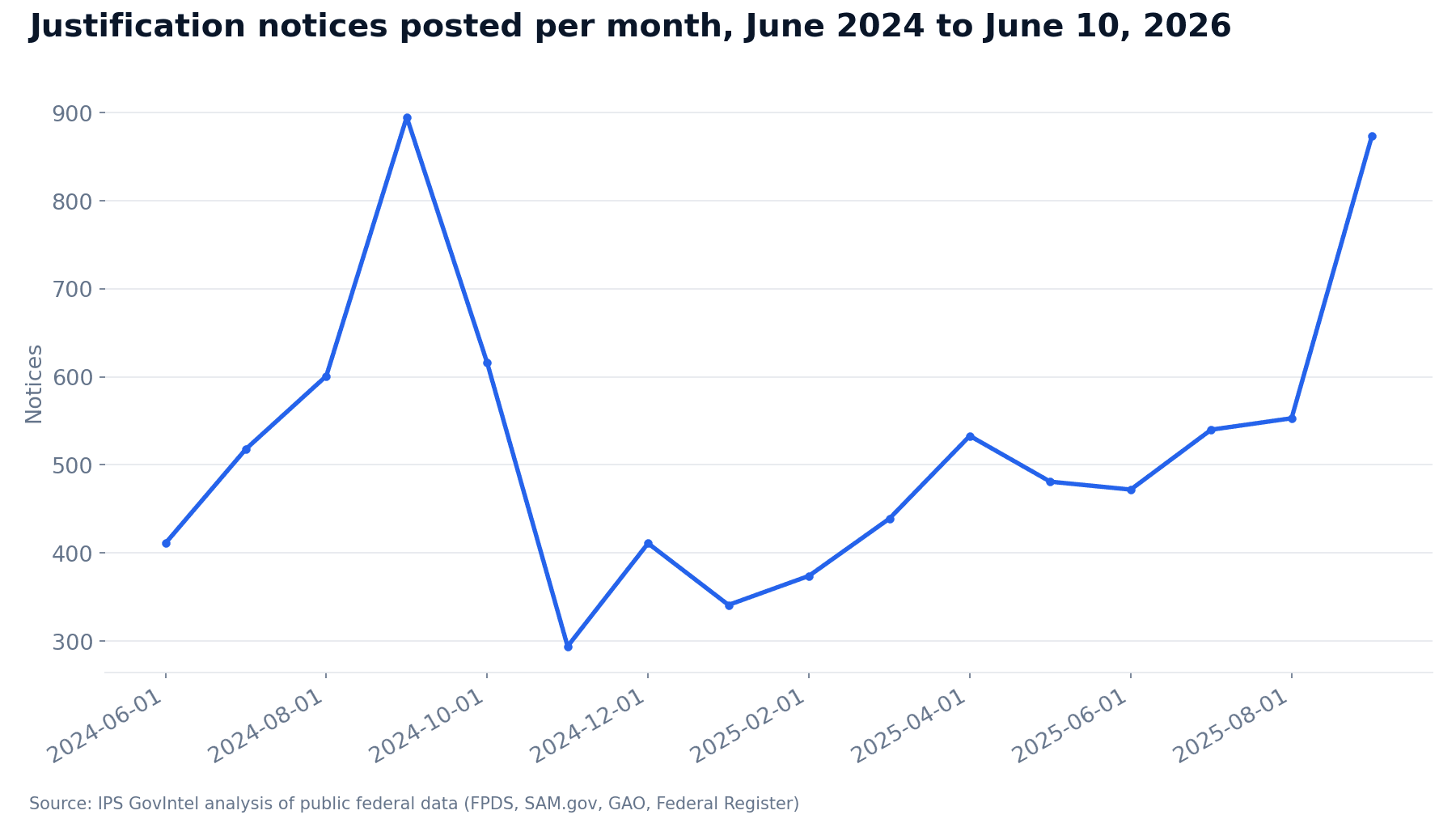
Agencies posted 874 justification notices in September 2025. Two months later, in November, they posted 288.
That's about three times as many in one month, and it wasn't a fluke. September 2024 had 895 and November 2024 had 294. Add up both years by calendar month and September comes out at 1,769 notices. November comes out at 582.
So every year, right before the fiscal year closes, agencies publish a pile of paperwork explaining why they didn't compete something. We're about three months out from that point, so it's a good time to set a baseline.
We track this in GovIntel, our federal contracting data warehouse. Unless I say otherwise, the window below is June 2025 through June 10, 2026, and the counts are justification notices posted publicly in that period.
💡 From the GovIntel desk this week
- $120.2 billion: DoD obligations, Dec 12, 2025 to Mar 12, 2026, versus $107.4 billion a year earlier. Award data lags about 90 days.
- $25.0 billion: DHS obligations in the same window, up from $4.6 billion a year earlier, making it the second-largest agency after DoD.
- 107: still-active total small-business set-aside solicitations posted in the week to June 10, alongside 18 SDVOSB and 10 8(a) notices.
- 5 of 8: GAO protest decisions in the week to June 10 were denials and the other 3 were dismissals; none were sustained.
- 23: GAO protests filed against VA in the 30 days to June 10, the most of any agency, just ahead of Navy at 22.
- FY2027: a DoD policy memo issued June 5 covers a change to contracting functional area certification for fiscal 2027; worth reading if you work with DoD buying offices.
Data as of June 10, 2026, from IPS GovIntel: federal awards, opportunities, protests, rules and budgets, updated daily.
Which authorities agencies cite
Every limited-competition justification rests on a statutory exception. Some get used far more than others.
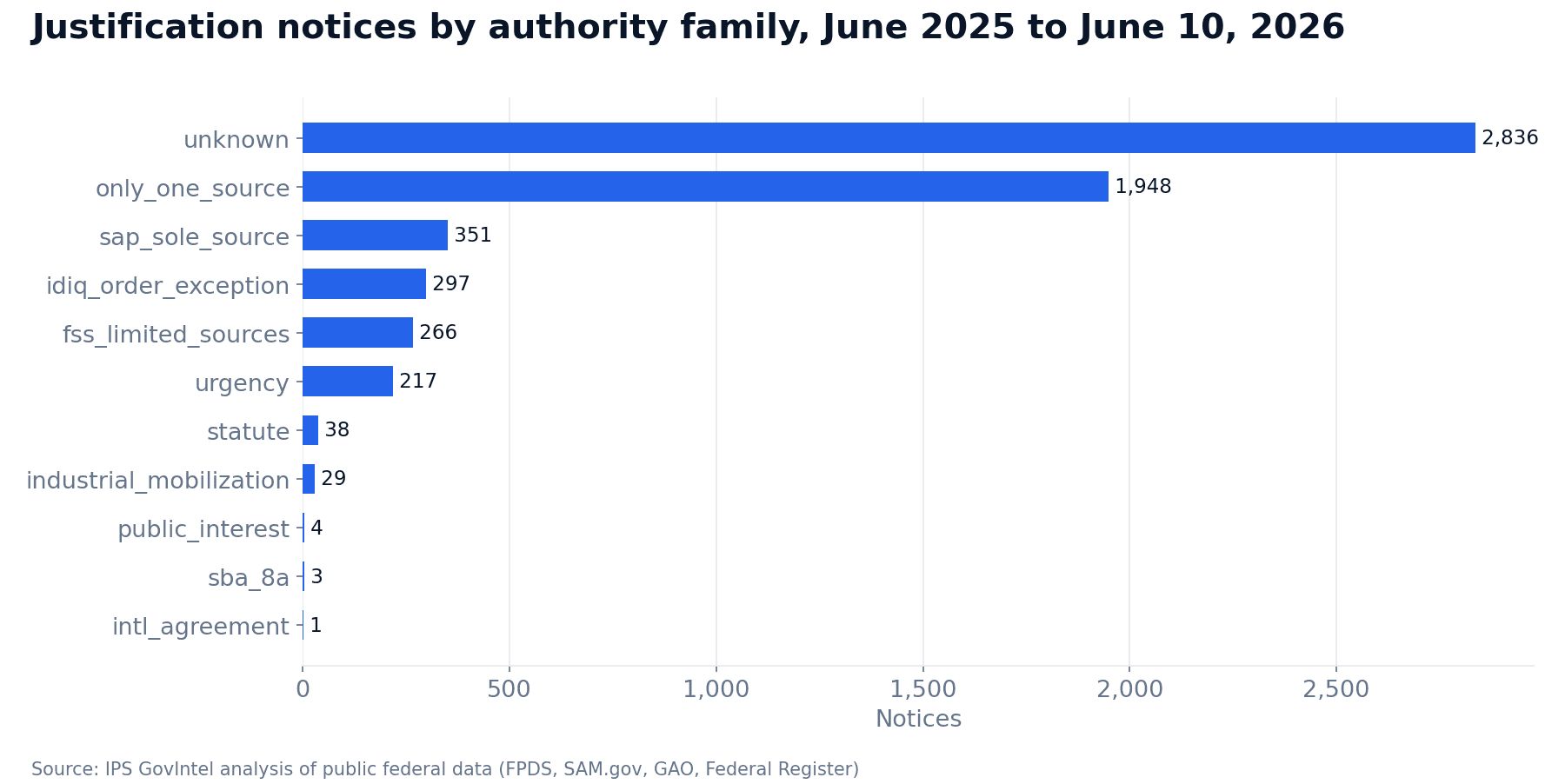
- Only one responsible source (FAR 6.302-1): 1,948 notices, $121.3 billion in stated value, median deal $4.6 million.
- Simplified acquisition sole source: 351 notices, median $268,000.
- Exceptions to fair opportunity on IDIQ orders: 297 notices, median $1.6 million.
- Limited sources on Federal Supply Schedule orders: 266 notices, median $1.0 million.
- Urgency (FAR 6.302-2): 217 notices, median $5.5 million.
- Authorized by statute: 38 notices, but $17.3 billion in stated value.
- Industrial mobilization: only 29 notices, with a median of $132.5 million.
One big caveat. Another 2,836 notices didn't map to any authority family in our parsing. That's the largest single bucket. It doesn't mean those buys lacked a justification. It means the posted text didn't let us classify it reliably. Read the rankings as directional.
What stands out to me is that "only one source" is the default. For each notice citing urgency, about nine claim that only one company can do the work. Urgency gets the headlines, but the sole-capability argument is where the volume is.
Who posts them, and how big the deals are
The Department of Defense is far ahead, with 3,551 notices in the window. Veterans Affairs is a distant second at 511. Then come Homeland Security (321), GSA (298), Justice (252), State (246) and Interior (243).
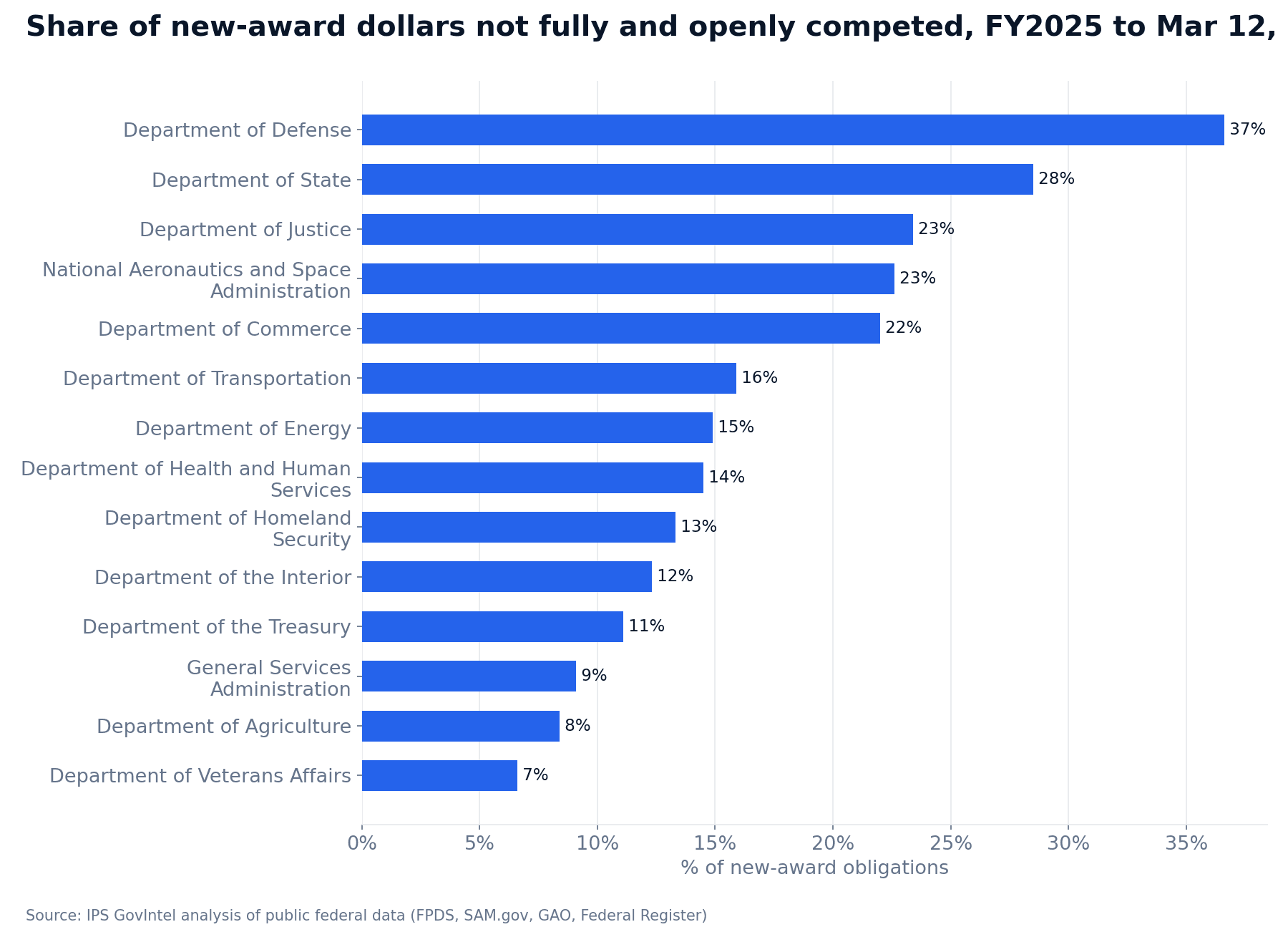
Notice counts are only part of the picture, so I also looked at award data. Counting new awards from the start of FY2025 through March 12, 2026, here is the share of each agency's dollars that went out under something other than full and open competition:
- DoD: 36.6%, or $95.9 billion of $262.3 billion
- State: 28.5%
- Justice: 23.4%
- NASA: 22.6%
- Commerce: 22.0%
- VA: 6.6%, out of $92.9 billion in new awards
DoD award data runs about 90 days behind, which is why that window stops in March. Notices and awards are separate datasets here, so I'm not claiming a given notice maps to a given award.
Across the government, the pattern is steady. New awards marked "not competed" came to $50.6 billion in FY2022, $55.0 billion in FY2023, $59.0 billion in FY2024 and $53.3 billion in FY2025. Full and open competition stayed between $152 billion and $160 billion over the same years. FY2026 through March 12 shows $23.2 billion not competed against $54.0 billion full and open. Limited-source buying isn't going away.
Deal size is the weakest part of the data. Of the notices in the window, 4,966 listed no dollar value at all. We pulled a value from the notice text for 723 more and from a structured notice field for 301. Among those 1,024 with a value, 229 were under $250,000, 264 were between $250,000 and $1 million, 204 between $1 million and $5 million, 148 between $5 million and $25 million, and 179 above $25 million.
Monthly dollar totals swing on a few very large actions. August 2025 alone showed $54.2 billion. Don't read much into any single month's dollars.
How these awards fare when protested
This section is short. We tied 28 protests to sole-source and other-than-full-and-open awards made from October 2022 through March 12, 2026. None were sustained.
At GAO, 13 were dismissed, 8 were denied, 3 were denied in part and dismissed in part, and 1 was withdrawn. At the Court of Federal Claims, 3 were denied. By authority, "only one source" drew the most protests (15), then "authorized by statute" (8). Neither had a sustain.
That's 28 protests, a small sample, and we can't give you a protest rate from it. The data also can't tell you how many of these buys were challenged successfully before award. It can't tell you how many companies changed an agency's mind during market research, which never shows up in a protest docket. What it does show is that once the justification is signed and the award is made, a reversal through protest has been rare.
What to do with this
- Read the justifications in your market. An "only one source" notice spells out which capability the agency thinks nobody else has. If you offer it, you now know what to put in front of that buying office before the next requirement.
- Plan for July through September. Notices climb through late summer and peak in September. Set your saved searches now and block time to read them.
- Spend market-research time where limited competition is common. DoD, State, Justice, NASA and Commerce all put more than a fifth of new-award dollars into non-competed awards.
- Answer sources sought notices and RFIs. My view, not something the data proves: it's harder to defend "only one source" when a qualified small business has gone on record.
- Don't build your plan around a protest. With zero sustains in 28, your effort is better spent earlier in the process.
The justification notice tells you the decision has already been made. Your chance to change it comes before the notice is posted.
Want this kind of read on your own pipeline or market? Get in touch.
Topics
Josh Parker
Founder of Indy-Pendent Solutions and flowState Software. Former Air Force combat rescue pilot, defense program manager, and capture strategist with 20+ years in defense acquisition.
Need help with your next capture?
Our software tools can help you win more government contracts.