In FY2025, 33.8% of competed simplified-acquisition awards drew exactly one offer. One in three.
Most small contractors picture a "competed" award as a crowded room. Sometimes it is. But a big share of the time, the government ran a competition and one company showed up.
That matters right now. It's early June, fiscal Q3 is closing, and the September rush is coming. If you're deciding where to spend proposal hours this summer, it helps to know where the room is full and where it's empty.
A note on scope first. The offer counts here come from awards coded competed under simplified acquisition procedures (SAP). In FY2025 that was 49,342 awards worth $12.16 billion. Full-and-open awards ($160.4 billion) and full-and-open-after-exclusion awards ($52.54 billion) carry far more dollars but aren't in this cut. So treat this as the picture for the smaller, faster buys where a lot of small-business volume happens. The window runs from October 1, 2024 through March 5, 2026. DoD award data runs about 90 days behind, so recent DoD activity is under-counted.
💡 From the GovIntel desk this week
- $170.1 billion: DoD contract obligations from Oct 1, 2025 through Mar 5, 2026, far above the next agency (VA at $31.2 billion). DoD award data lags about 90 days.
- $8.56 billion: total small business set-aside obligations so far in FY2026 (through Mar 5), down about 10% from $9.55 billion in the same stretch of FY2025.
- $1.09 billion: competed 8(a) obligations so far in FY2026, versus $1.40 billion in the same stretch of FY2025. Less money is moving through 8(a) competitions.
- 2,298: new small business set-aside notices (solicitations, presolicitations, sources sought) posted in the week to June 3 across 524 offices. Plenty to bid on, so screening matters.
- 26 GAO decisions: issued May 4 to June 3. 17 were denied outright and 2 sustained; the other 7 were dismissed or split. These are decisions, not all protests filed.
- $1.73 billion: FY2027 request for Navy MSE Missile procurement, versus $47 million in the prior request. One of the largest line shifts in the budget book.
Data as of June 3, 2026, from IPS GovIntel: federal awards, opportunities, protests, rules and budgets, updated daily.
One Offer Is a Normal Outcome, Not a Fluke
We track this in GovIntel, our federal contracting data warehouse, and the single-offer share has barely moved in four years: 33.5% in FY2022, 34.3% in FY2023, 34.7% in FY2024, 33.8% in FY2025.
The crowded end has moved, though. The share of awards drawing five or more offers rose from 24.3% in FY2022 to 29.4% in FY2025, and the two-offer share fell from 19.5% to 16.6%. One-offer awards held steady while the crowded end grew.
FY2026 to date looks much more crowded (24.8% single-offer, 45.6% five-plus), but I wouldn't trust that yet. One month, February 2026, accounts for 8,454 awards with 75.9% drawing five or more offers. That looks like a batch of similar awards, not a change in the market. Until more of FY2026 comes in, FY2025 is the better baseline.
Set-Asides Fill the Room
This is the part that surprises people. Set-asides protect you from large businesses. They don't protect you from other small businesses.
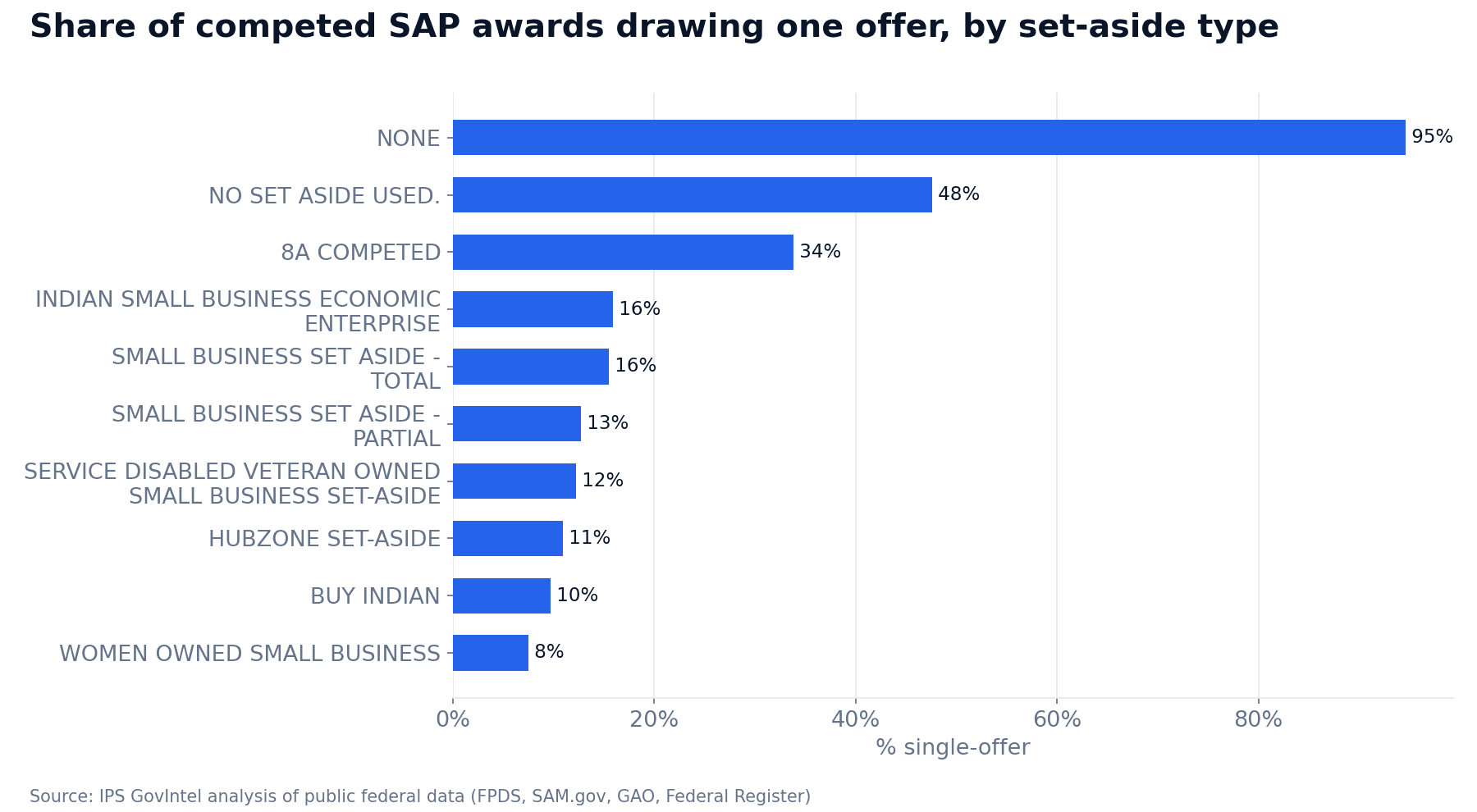
From October 2024 through March 5, 2026:
- Small business set-asides (total): 32,515 awards, median of 5 offers, 15.5% single-offer.
- No set-aside used: 26,267 awards, median of 2 offers, 47.6% single-offer.
- SDVOSB set-asides: median of 5, 12.2% single-offer.
- WOSB set-asides: median of 6, just 7.5% single-offer.
- HUBZone set-asides: 10.9% single-offer.
When a contracting officer sets an award aside, the response is strong. Unrestricted SAP awards are where nearly half the competitions end with one bidder. Some of that is niche products only a few firms supply. Still, a lot of small firms filter these out by habit, so they never see them.
The split shows up inside agencies too. At DoD, unrestricted competed awards went single-offer 49.4% of the time, against 20.8% for set-asides. VA: 50.6% versus 18.2%, with a median of one offer on unrestricted awards. Justice: 62.0% versus 15.1%. HHS: 48.5% versus 13.9%. Agriculture shows 91.6% versus 1.2%. That gap is so extreme I'd treat it as a coding pattern before I'd treat it as a market signal.
DoD dominates the volume: 43,414 competed SAP awards in the window, with a 35.1% single-offer rate. That's the highest of any agency with at least 300 awards. Recent DoD awards are still missing because of the lag.
Industry shows the same thing. Manufacturing codes have the thinnest competition: aircraft parts (NAICS 336413) went single-offer 52.6% of the time across 4,039 awards, industrial valves (332911) 57.7%, and machine shops (332710) 64.0% across 222 awards. Services aren't immune. Electronic equipment repair (811210) came in at 42.2%, and NAICS 541990 at 39.5%.
Size matters as well. Awards between $250K and $1M were single-offer 40.4% of the time, compared with 29.2% for awards under $250K.
What Competition Does to Price
This is where the data gets thin, so I'll be careful.
For professional services (PSC "R" codes), I compared each award's size to the median award in the same PSC and NAICS pair (pairs with at least 15 awards), then grouped awards by how many offers they drew.
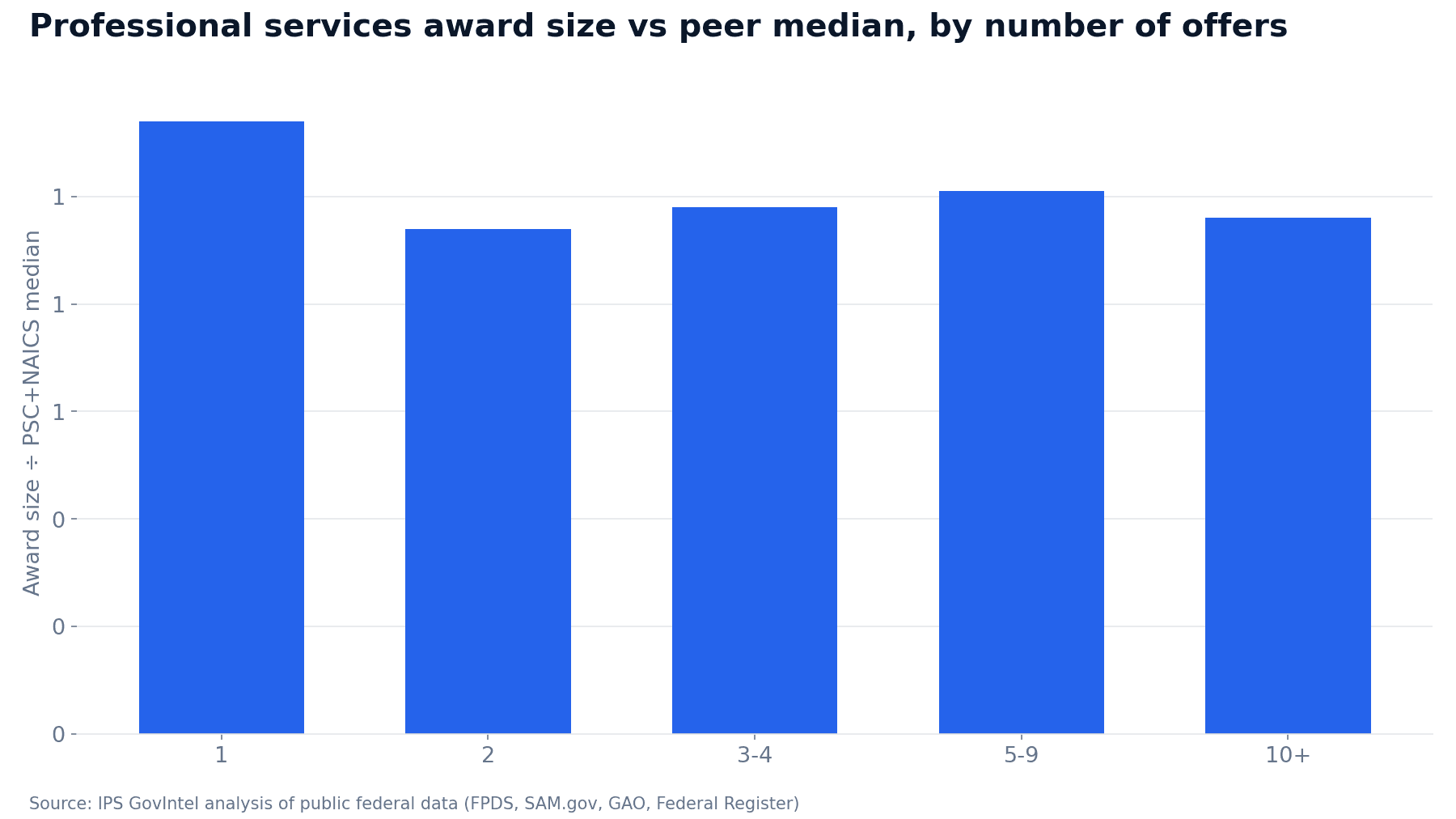
Single-offer awards came in at a median of 1.14x their peer median. Every bucket with two or more offers landed between 0.94x and 1.01x. The top quartile of single-offer awards hit 2.14x.
So the second offer seems to matter most. Going from one offer to two moves the median from 1.14x to 0.94x. After that, the median barely moves, whether the award drew three offers or ten.
Caveats, and they matter. These buckets are small: 128 single-offer awards, 52 two-offer awards. This compares award size, not unit price, so scope differences are mixed in. It shows a relationship, not a cause. What it suggests is that a sole bidder doesn't automatically land a big premium, but single-offer awards do sit higher and spread wider than the rest.
The September Effect
Timing is the last factor. Sole-source and limited-source justification notices (J&As) spike at fiscal year-end: 895 in September 2024 and 874 in September 2025, compared with 294 in November 2024 and 288 in November 2025.
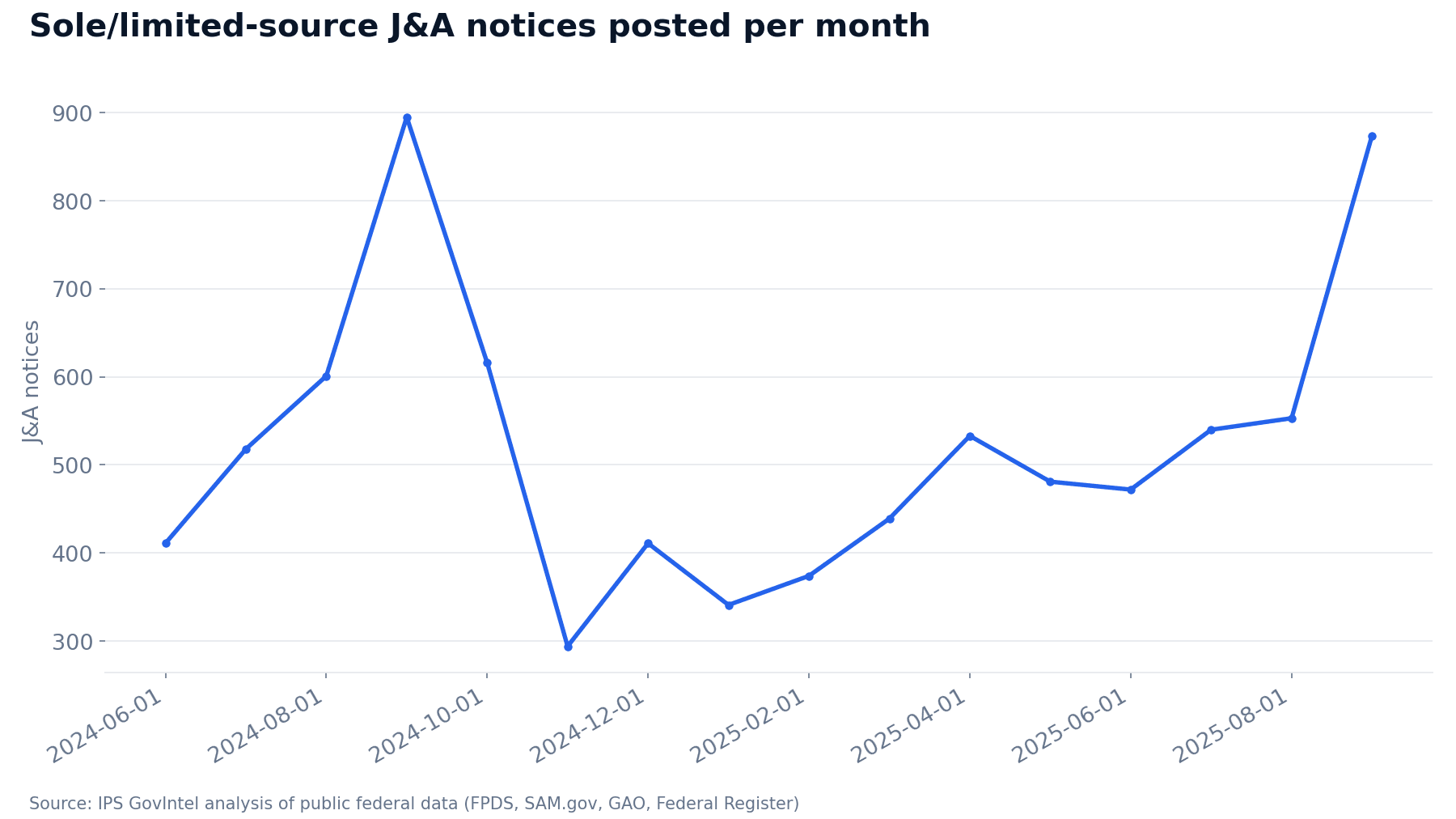
The award data shows the same volume pressure. September 2025 had 7,037 competed SAP awards, roughly double October 2025's 3,458. The single-offer rate didn't follow, though: September 2025 was 32.1%, a bit under the period average. August 2025 had the highest rate in the window at 41.9%. That is one year of data, so I wouldn't build a calendar on it.
As of today, J&A notices are running at 506 for April and 444 for May, slightly under the 533 and 481 posted in those months a year earlier. Last year's September spike came after a summer climb. June's count so far is too small to read.
What to Do With This
- Stop filtering out unrestricted SAP awards. Nearly half drew one offer. If you're qualified for the work, that's a thinner field than most set-asides give you.
- Price set-asides like a crowded room. A median of five offers on small business set-asides means your price has to win on its own.
- Look hard at product-heavy and repair NAICS codes. Machine shops, valves, aircraft parts and equipment repair are where single-offer awards cluster.
- Keep proposal capacity open in August. It topped the window for single-offer awards last year. Treat that as a hint, not a rule.
- If you're the only bidder, don't overreach. The median single-offer award sat 14% above its peers. Price to win the next competition too.
A competed award isn't the same as a competitive one. Go where the bidders aren't.
Want this kind of read on your own pipeline or market? Get in touch.
Topics
Josh Parker
Founder of Indy-Pendent Solutions and flowState Software. Former Air Force combat rescue pilot, defense program manager, and capture strategist with 20+ years in defense acquisition.
Need help with your next capture?
Our software tools can help you win more government contracts.