Of the 367,479 active labor category rates in GSA's CALC+ data, 51,075 carry a next-year price that's exactly the same as this year's. No escalation at all.
That isn't the typical case. But it's a lot of rate cards, and it says something useful: what schedule holders actually put into their escalation varies more than most proposal teams assume.
FY2027 has started, and teams are setting escalation for T&M and labor-hour bids right now. This piece looks at what ceiling rates on the schedule actually do.
The data comes from GovIntel, our federal contracting data warehouse. It covers rates on contracts running through at least November 23, 2026, from a snapshot refreshed between September 30 and November 22, 2026.
💡 From the GovIntel desk this week
- 1,529 total small business set-aside solicitations posted this week, down from 1,841 the prior week. Fewer set-aside bids to chase; one week's count shows no trend.
- 214 SDVOSB set-aside solicitations, down from 281; HUBZone fell to 75 from 127. Niche set-aside pipelines can swing quickly week to week.
- 10 GAO protests filed this week versus 33 the week before. Our data can't say why, and recent filings may still be incomplete.
- $111 million was the largest non-DoD new award this week: a Homeland Security construction action (NAICS 236220), one of four same-day awards to one firm.
- $450 million ceiling on each of several Army competitive awards announced Nov 20, including small businesses. DoD announcements here are provisional and lag FPDS by about 90 days.
- 2,202% jump in the FY2027 request for Defense Production Act Purchases, to about $30.4 billion from $266 million. It's a request, not an appropriation.
Data as of November 25, 2026, from IPS GovIntel: federal awards, opportunities, protests, rules and budgets, updated daily.
The contractual step-up: mostly 2 to 4 percent
Most CALC+ rates include a current price, a next-year price and often a second-year price. Comparing them shows the escalation each vendor wrote into its schedule.
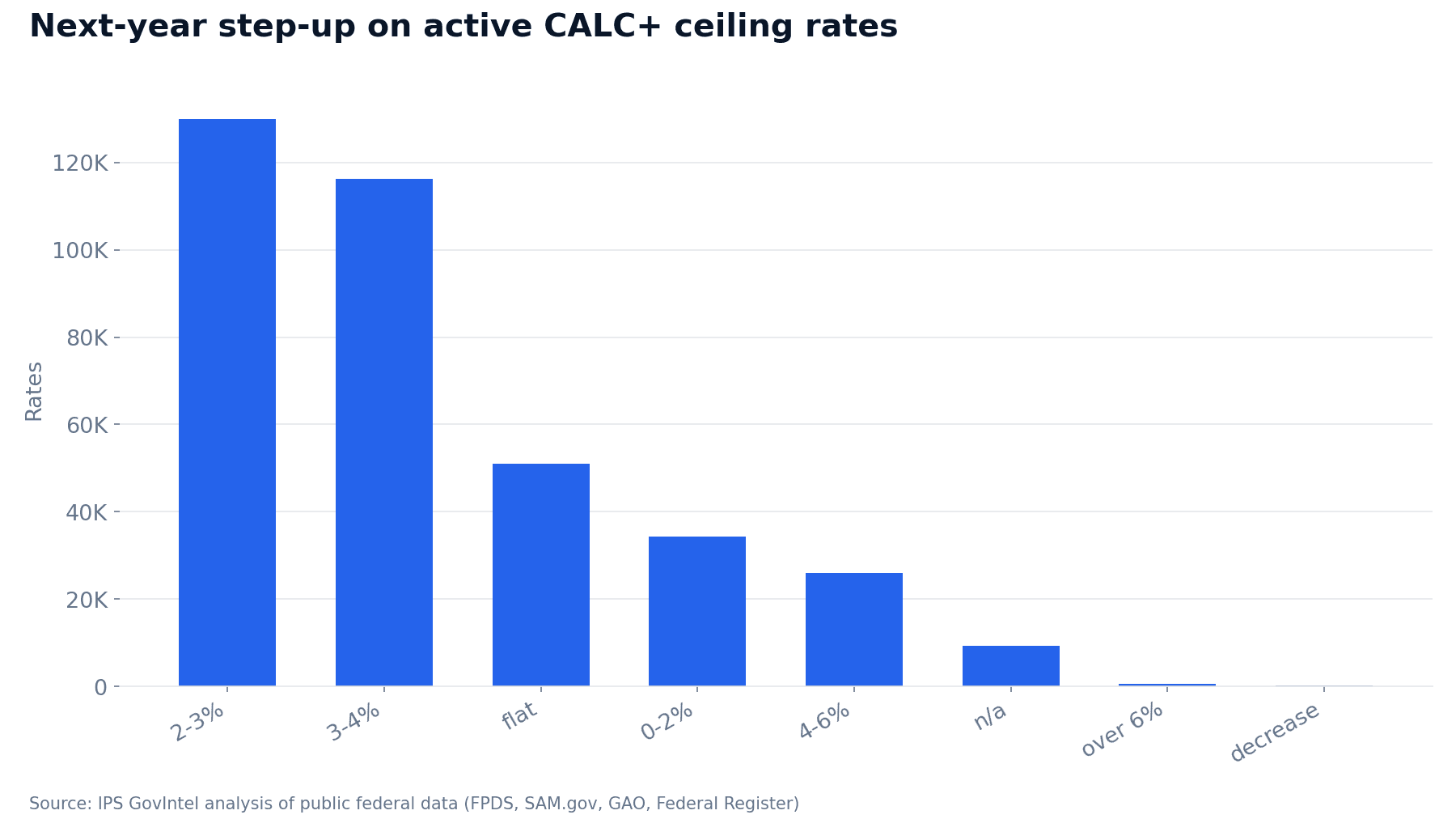
The two biggest buckets are 2-3% (129,932 rates) and 3-4% (116,237 rates). After those come flat (51,075) and 0-2% (34,288). Only 25,913 rates step up 4-6%, and just 586 go above 6%. Another 199 actually decrease next year. A further 9,249 rates lack the price data to calculate a step-up.
So if your proposal escalates labor above 4% a year, you're in a small minority of schedule holders: about 7% of rates. That doesn't make you wrong, since your labor market may justify it. It does mean you should be ready to explain it.
One caution on the flat group. A next-year price identical to the current one may be a deliberate choice, or it may just be how some vendors filled in the fields. The data can't tell us which.
Small vs. other-than-small: a small but real gap
Split by business size, the medians look like this:
- Small businesses: 254,457 rates, median ceiling of $124.82/hour, median next-year step-up of 2.7%
- Other-than-small: 113,022 rates, median ceiling of $137.35/hour, median next-year step-up of 3.0%
The gap carries into year two. For rates with a second-year price, small businesses have a median second step of 2.7% and a median two-year total of 5.47%. Other-than-small vendors come in at 3.0% and 6.08%.
A third of a point a year looks minor. It compounds over a five-year base-plus-options period, though, and it means small businesses start lower and escalate more slowly. I'd guess part of that is deliberate price competitiveness and part is small firms locking in modest escalation at award without revisiting it. The data can't tell those apart.
Category matters too. Most of the large SIN groupings fall between roughly 2.0% and 3.2% median step-ups. Two outliers:
- Office Management; Miscellaneous (4,060 rates): median ceiling of $50.69, median step-up of just 0.31%. Escalation is barely there.
- The broad Security and Protection groupings that also span IT, office management and scientific services: median step-ups of 4.1% on 4,666 and 4,518 rates. That's well above everything else at that volume.
What education and clearance actually buy
Education requirements move the median ceiling much more than clearance does:
| Education | No clearance | Clearance | |---|---|---| | High School | $69.22 | $76.96 | | Associates | $89.83 | $94.39 | | Bachelors | $135.76 | $137.46 | | Masters | $191.89 | $186.11 | | PhD | $221.34 | (too few) |
The jump from bachelor's to master's is about $56 an hour at the median. The clearance flag adds only a couple of dollars at the bachelor's level, and at the master's level the cleared median is lower. Don't read too much into that. We can't see how consistently clearance is tagged in CALC+, and a schedule ceiling isn't a cleared-work price. Still, if your pricing story depends on a clearance premium, the schedule data won't support it on its own.
When rates reprice, and what we can't tell you
CALC+ ceilings aren't static. In our change history, 15,324 rates changed in October 2026, and 19,891 changed in November through the 22nd. Separately, 35,215 active rates (9.6%) show a price change in the past 12 months. Our change history only shows October and November 2026, so treat these as a snapshot, not a long-term repricing rate.
Contract end dates show when the next round of renewals arrives:
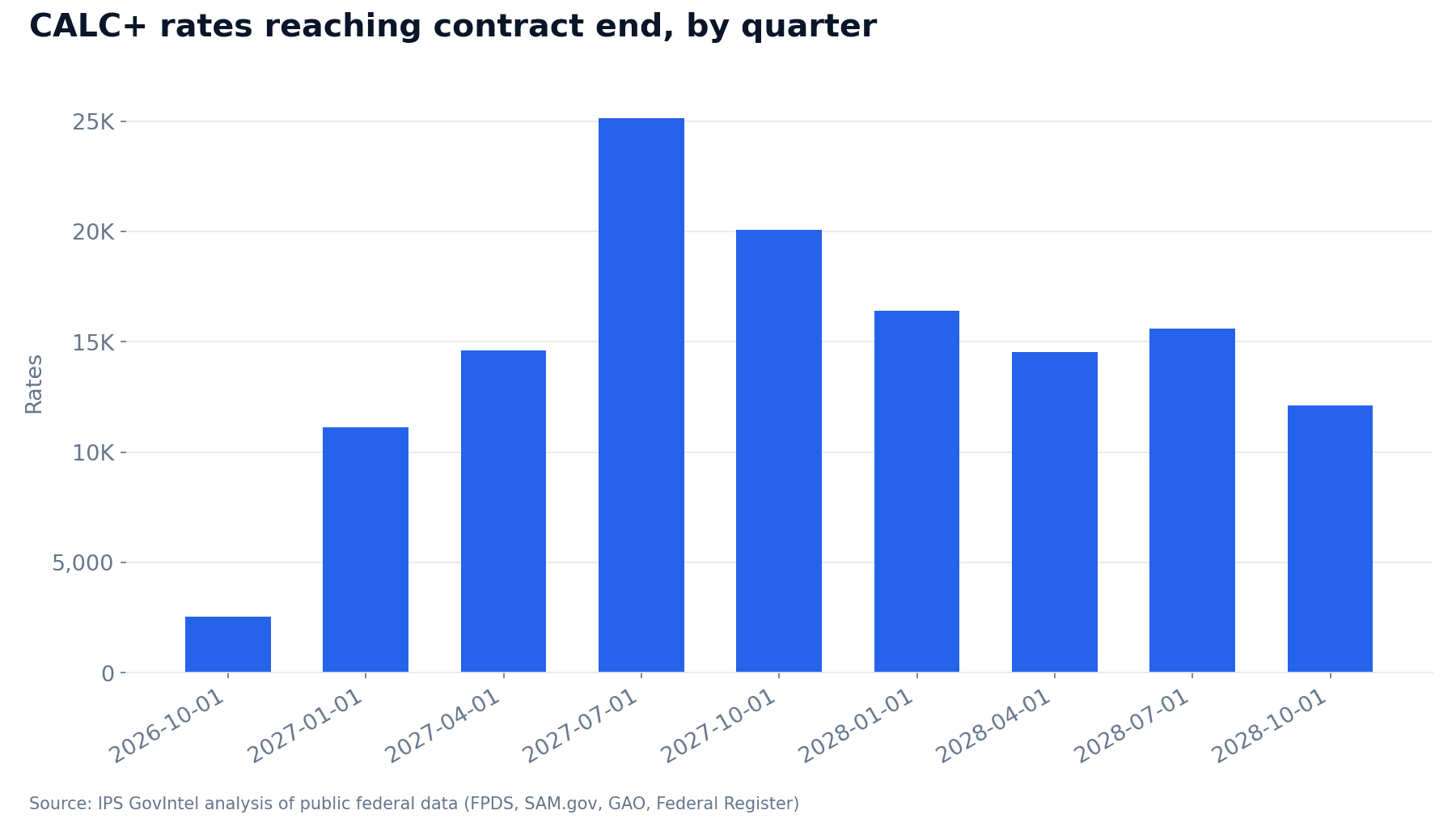
The peak is the quarter starting July 2027, late in FY2027: 25,120 rates across 349 vehicles reach their current contract end. Rate cards in that window may be renewed, extended or replaced, so published ceilings could shift then. We can't see which.
Two things this data does not show.
First, ceiling rates aren't awarded prices. A CALC+ ceiling is the most a vendor can charge on the schedule. Task order pricing can come in below it. Use ceilings to frame a range, not as proof of what the government pays.
Second, these are the escalation terms vendors published, not what they negotiate on individual task orders. A rate card's step-up tells you the contractual cap, not the price a customer ends up paying.
What to do with this
- Benchmark your escalation against 2.7% (small) and 3.0% (other-than-small). If you're well above, document why: local wage data, ECI, or a specific scarce skill set.
- Check your own schedule's out-year rates. If your rate card shows no step-up, find out whether that's intentional. If it is, flat pricing erodes your margin as wages rise. Plan any modification before your next option or anniversary date.
- Price education levels, not clearance flags. Schedule data supports a meaningful master's premium. It doesn't support a clearance premium by itself.
- Put the July 2027 quarter on the calendar. If you compare against published ceilings during pricing, expect the benchmark set to shift around then.
- Use ceilings as a ceiling. Check wrap rates against them, but build your price-to-win from actual award data, not CALC+.
Escalation is one line in your pricing model, and it's one the schedule gives you a benchmark for.
Want this kind of read on your own pipeline or market? Get in touch.
Topics

Josh Parker
Founder of Indy-Pendent Solutions and flowState Software. Former Air Force combat rescue pilot, defense program manager, and capture strategist with 20+ years in defense acquisition.
Meet GovTrace
The data warehouse behind our weekly market Insights: contract history, notices, decisions, policy, and hiring, connected around the clock.