Of the 858 individual protest grounds GAO ruled on in written decisions between October 1, 2024 and April 8, 2026, 51 were sustained. That's about 6%.
The other 807 broke down as 587 denied, 208 dismissed and 12 never reached. If you've ever sat through a bad debrief and thought "we should protest this," that's the baseline you're working against.
We're past the midpoint of FY2026, and September award season is ahead. Debriefs and protest decisions follow awards, so this is a good time to look at what the record shows: what usually happens, which arguments hold up, and where protests are piling up. All of it comes from GAO decisions and protest filings we track in GovIntel, our federal contracting data warehouse.
💡 From the GovIntel desk this week
- 3,169 combined synopsis/solicitations posted to SAM.gov in the week to April 8, up from 2,857 the week before.
- 1,574 standalone solicitations posted in the same week, down from 1,901 the week before.
- 533 of this week's standalone solicitations were total small business set-asides, versus 589 the week before.
- $94.8 billion in DoD contract obligations from Oct 1, 2025 to Jan 8, 2026. Award data lags about 90 days, so recent weeks are missing.
- $22.5 billion in Veterans Affairs obligations over the same window, second only to DoD.
- 10 FAR (Title 48, chapter 1) sections changed in March 2026, all substantive, versus 97 in October 2025.
Data as of April 8, 2026, from IPS GovIntel: federal awards, opportunities, protests, rules and budgets, updated daily.
The outcome picture, FY2023 to now
Denial is the default, and it has been for years. Here are decisions by fiscal year (October to September):
- FY2023: 297 decisions, 211 of them flat denials, 25 sustained outright.
- FY2024: 297 decisions, 188 flat denials, 45 dismissals, 25 sustained outright.
- FY2025: 313 decisions, 196 flat denials, 57 dismissals. Counting partial sustains, 27 decisions carried a sustain. That's roughly 9%.
- FY2026 to April 8: 143 decisions, 9 with any sustain. That's about 6%.
The "sustained outright" and "any sustain" figures are not the same measure, so don't line them up too tightly across years. The 6% in the headline counts individual grounds. The 6% for FY2026 counts whole decisions. They happen to land close together.
The past three months have been especially lopsided. January, February and March together produced 96 decisions and three sustains. March had 18 decisions and none sustained. The first week of April added five more, and every one included a denial. The record also shows no decisions at all for October 2025.
One caveat matters a lot here: this is written decisions only. GAO protest filings in our data run from November 2025 on, and they ran between 88 and 176 a month through March 2026. Written decisions ran between 12 and 40 a month over the same stretch. The gap is large. Many protests never produce a written decision, and this data can't show what happened to them. So the "6%" describes the cases that got a written decision, not every protest filed.
Which grounds actually win
This is the part worth bookmarking. Here are the most common ground types since FY2025:
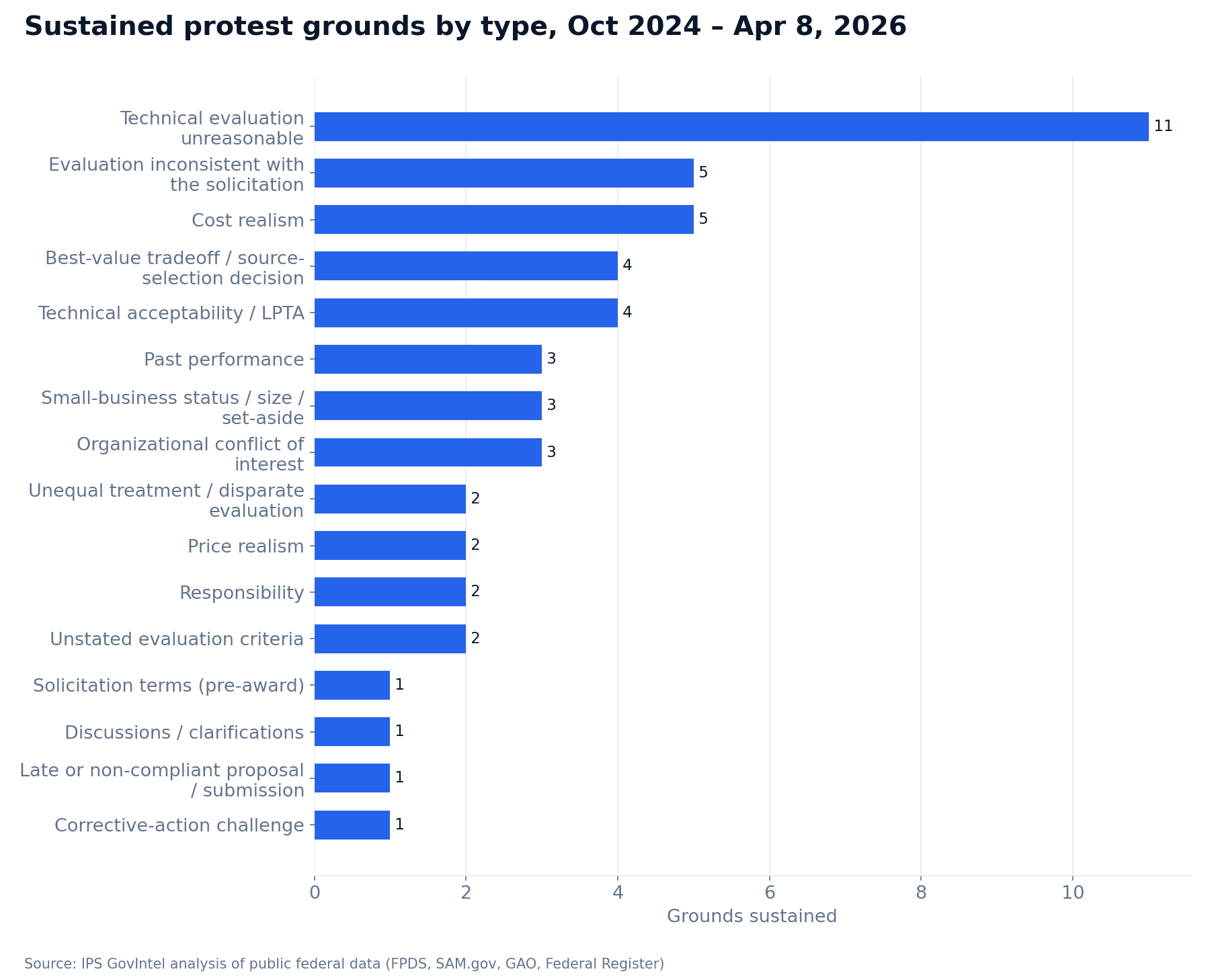
The ground protesters raise most is "technical evaluation unreasonable." It came up 157 times, and 135 of those were denied. Eleven were sustained, about 7%. The best-value tradeoff challenge did worse: 88 raised, 4 sustained. Past performance went 3 for 55, and discussions went 1 for 46. Key personnel and price reasonableness didn't produce a single sustain (0 of 13 and 0 of 26).
The grounds with higher sustain rates look different:
- Cost realism: 20 raised, 5 sustained (25%).
- Evaluation inconsistent with the solicitation: 23 raised, 5 sustained (22%), and none dismissed.
- Technical acceptability / LPTA: 31 raised, 4 sustained.
- Organizational conflict of interest: 23 raised, 3 sustained.
- Unstated evaluation criteria: 15 raised, 2 sustained.
The pattern is fairly plain. Arguments that say "the agency should have scored us higher" rarely win, because evaluators get a lot of room on judgment calls. Arguments that say "the solicitation said X and the agency did Y" or "the agency's own cost analysis doesn't hold up" point to something that can be checked against the record. Those do noticeably better.
The samples are small. Five sustains out of 20 is not a law of nature. Still, the gap between 7% and 25% is too large to ignore.
Then there's the category that loses on procedure: timeliness, jurisdiction and standing. It came up 75 times, produced 64 dismissals and zero sustains. Pre-award challenges to solicitation terms were raised 67 times, with 25 dismissed and 1 sustained.
Corrective action and costs are both trending down
Corrective action is the outcome many protesters are really after. The agency re-evaluates, re-opens discussions or makes a new award decision. Here's how often it shows up in written decisions:
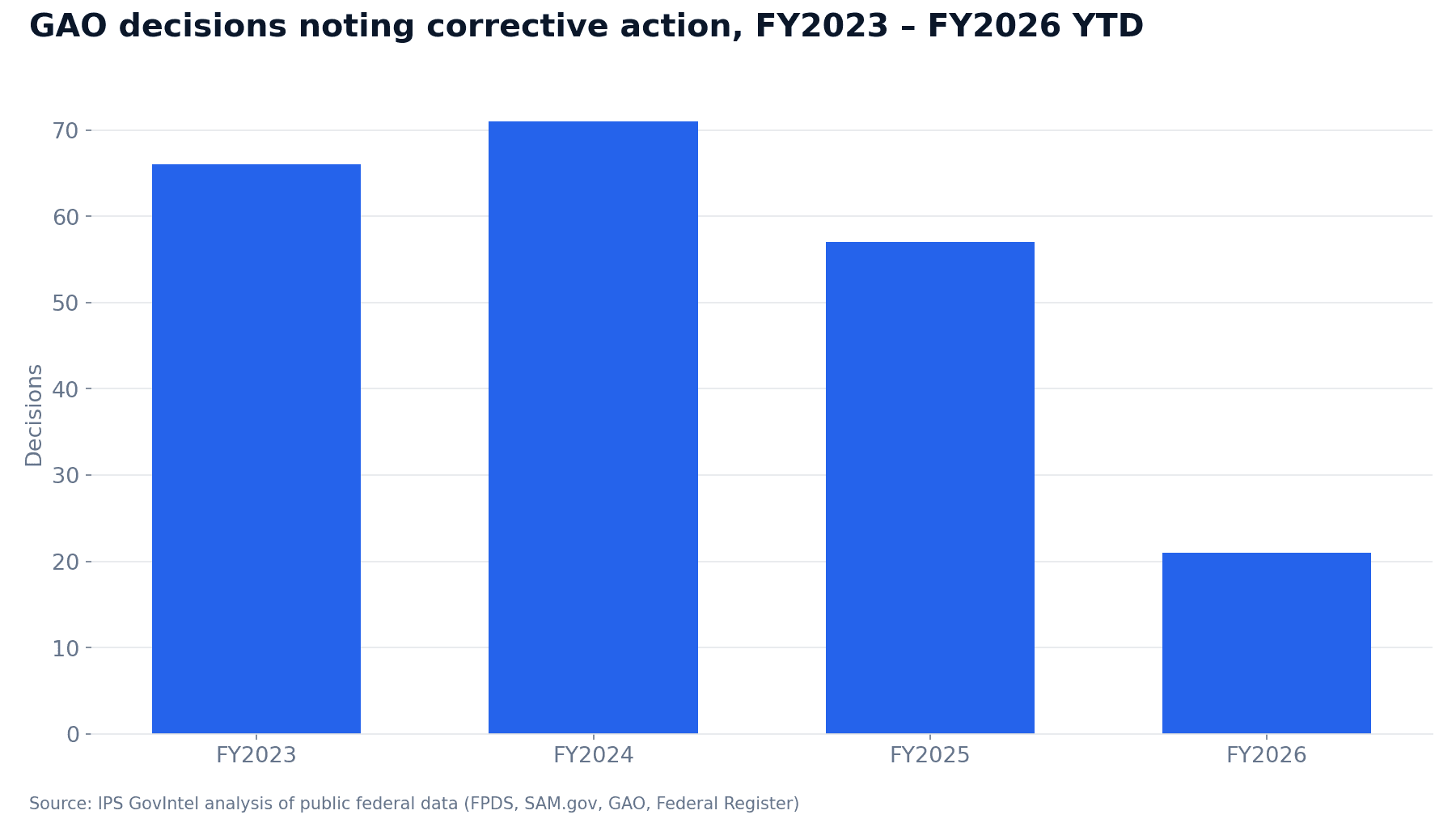
That's 66 of 297 decisions in FY2023 (22%), 71 of 297 in FY2024 (24%), 57 of 313 in FY2025 (18%), and 21 of 143 so far in FY2026 (15%). Remember the earlier caveat: this only counts corrective action noted in written decisions, so treat it as a directional signal, not a full count.
The trend in GAO cost recommendations is steeper. GAO recommended that agencies reimburse protest costs in 18 decisions in FY2023, 15 in FY2024, 6 in FY2025 and one so far in FY2026. If your protest plan assumes you'll get your legal fees back, the record doesn't support that.
Where protests cluster
Here are FY2026 filings through April 8, by agency:
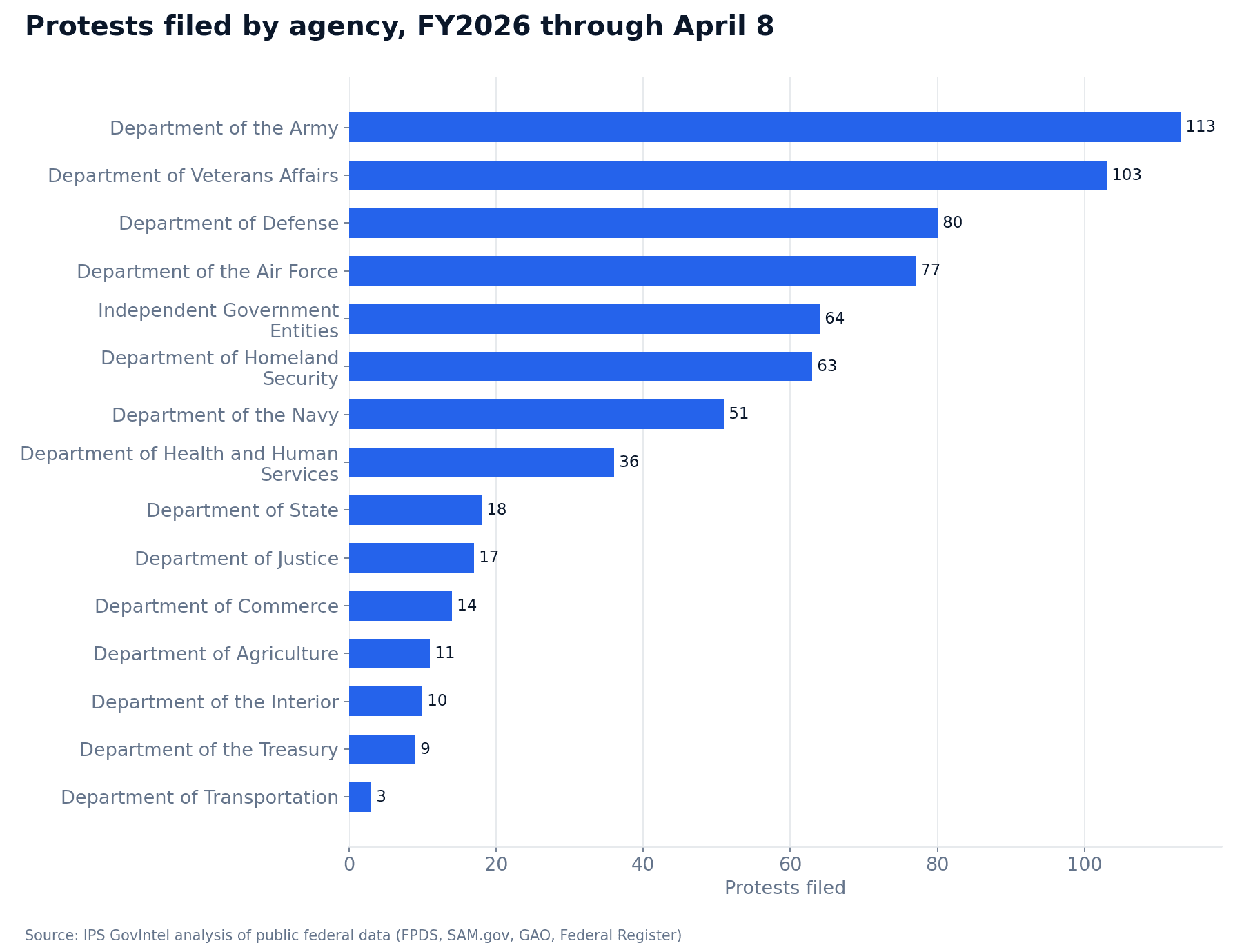
The Army leads with 113 filings and VA follows with 103. Next come DoD components reported at the department level (80), the Air Force (77), independent government entities (64), DHS (63) and the Navy (51).
Decided cases since FY2025 show a different picture by agency:
- VA: 49 decisions, the most of any agency, but only 1 sustain and 7 with corrective action.
- Air Force: 43 decisions, 6 sustains, 9 with corrective action.
- Army: 31 decisions, 5 sustains, 8 with corrective action.
- GSA: 24 decisions, no sustains.
- Navy: 22 decisions, no sustains, no corrective action noted.
- Army Corps of Engineers: 3 sustains out of 12 decisions under one agency label.
A data note on the Corps: its decisions are split across several naming variants in the record, so treat agency-level figures for it as approximate.
More filings at an agency doesn't mean better odds there. VA draws plenty of protests, but in our data the decided cases have rarely gone the protester's way.
What to do with this
- Compare the debrief to the solicitation, line by line. For every weakness you were assessed, find the evaluation language it came from. If you can't find it, you may be looking at an evaluation that departs from the solicitation or uses unstated criteria. Those are the grounds that win more often.
- Don't build a protest on disagreeing with your scores. Unreasonable technical evaluation was raised 157 times and denied 135 times. Unless you can show the agency broke its own rules, a better score next time is cheaper than a protest now.
- On cost-type bids, review the cost realism analysis closely. It went 5 for 20. If the agency's realism adjustments don't add up, that's a specific, checkable argument.
- Know your filing deadlines before the debrief starts. Timeliness and standing problems produced 64 dismissals and zero sustains. Missing a deadline is the most avoidable way to lose.
- Assume you won't recover costs. One cost recommendation so far this fiscal year. Decide whether to protest based on whether the possible win is worth the spend, because you probably won't get the spend back.
Protesting is a legitimate tool. The record just shows it works best when your argument is about the rules, not about your scores.
Want this kind of read on your own pipeline or market? Get in touch.
Topics

Josh Parker
Founder of Indy-Pendent Solutions and flowState Software. Former Air Force combat rescue pilot, defense program manager, and capture strategist with 20+ years in defense acquisition.
Need help with your next capture?
Our software tools can help you win more government contracts.