FPDS shows the Department of Defense obligating $9.2 million on contracts between October 1 and October 28, 2026. In the same window last year, the figure was $10.9 billion.
That number isn't a collapse. It's early. DoD contract actions reach FPDS about 90 days after they happen, so in early November the Pentagon's October barely shows up. It's the same every year: don't read October totals at face value.
What you can read is the rest of the picture. Several civilian agencies are ahead of last October, others are behind, services work is leading by industry, and SAM.gov is busier than a year ago.
We track this in GovIntel, our federal contracting data warehouse. For this piece I compared the October 1-28 window across FY2022 through FY2027, using data loaded through October 31, 2026.
💡 From the GovIntel desk this week
- 1,473 small-business set-aside notices (total) posted on SAM.gov this week across solicitations, combined synopses, presolicitations and sources sought, up from 1,367 the prior week.
- 101 HUBZone set-aside notices posted this week versus 68 the prior week; women-owned program notices rose from 30 to 49.
- 305 new solicitations and presolicitations from one NAVSUP Weapon Systems Support office this week, up from 231; DLA offices held most of the other top slots.
- $1.5 billion Medical Surgical Prime Vendor award to Cardinal Health, one of three awards under solicitation SPE2DV-26-R-0001 in the week's ten largest DoD announcements; announcements are provisional, pre-FPDS.
- $99 million Shift5 entry, a correction to an Oct. 14, 2026 announcement and the only small business among the week's ten largest DoD announcements.
- Oct. 27 DoD policy memo on efficiency assurance for fixed-price contracts and other transactions; our data lacks its text, so read it directly.
Data as of November 4, 2026, from IPS GovIntel: federal awards, opportunities, protests, rules and budgets, updated daily.
The headline total is mostly a lag artifact
From October 1-28, 2026, contract actions show $8.11 billion in obligations across 95,976 actions. The same window came in at $31.3 billion in 2021, $37.35 billion in 2022, $31.17 billion in 2023, $36.93 billion in 2024, and $17.07 billion in 2025.
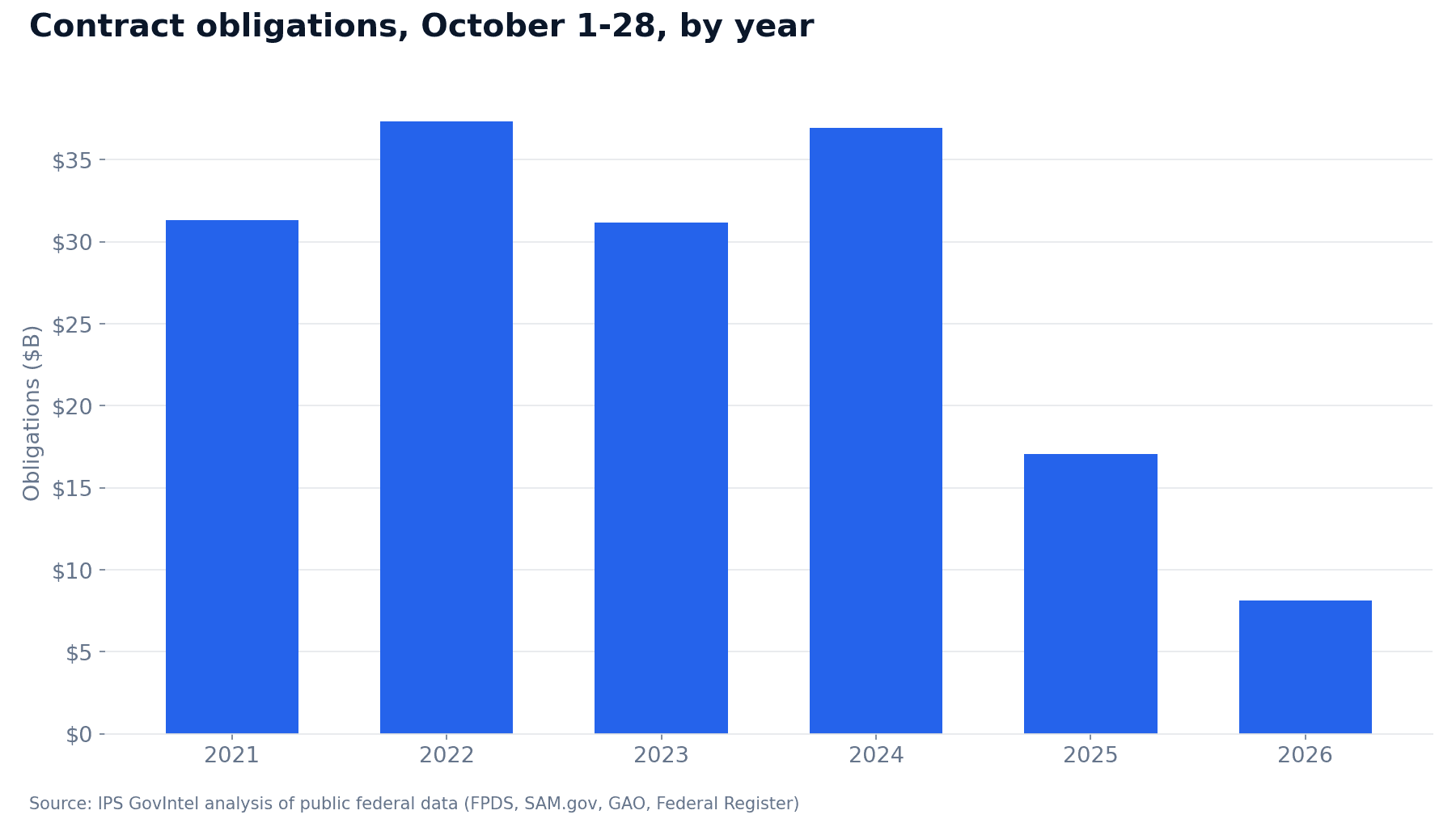
The action counts tell you what's going on. Last year's window had 338,313 actions, and DoD accounted for 265,723 of them. This year DoD has 12 so far. That's missing data. It doesn't tell us whether spending fell.
To fill the gap, GovIntel adds DoD's published award announcements as provisional records until FPDS catches up. On that basis, DoD has about $3.5 billion across 4,627 provisional actions for October 1-28. That's a floor, not a total, and it still sits well below last year's $10.9 billion. I can't say how much of the remaining gap is lag and how much is real.
The announcement stream needs its own caveat. DoD posted 165 announcements of $7.5 million or more in October 2026 with a headline value of $168.48 billion. Only $2.0 billion of that was obligated. The rest is contract ceilings. The largest single announcement was $8.0 billion. Small businesses received 16.4% of the announcements. Our announcement table has no October 2025 entries, so I can't give you a clean year-over-year comparison.
One more caution: October 2025 was the weakest October in this series at $17.07 billion. Gains against it will look better than they are.
Civilian agencies: mixed, with some big early movers
Several civilian agencies have already passed their total for the same window last October:
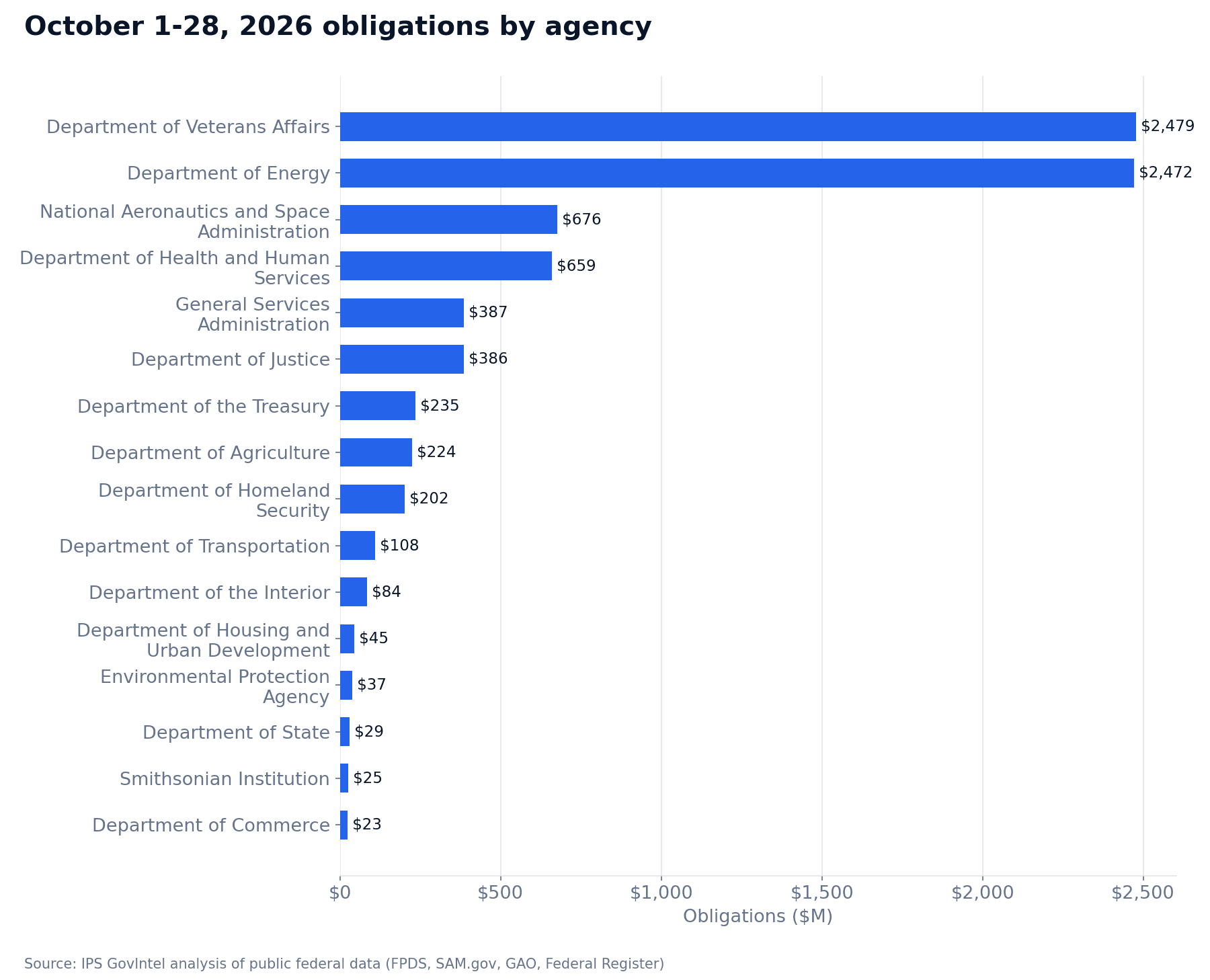
- Energy: $2.47 billion, up from $773.2 million
- NASA: $675.5 million, up from $22.5 million
- HHS: $659.4 million, up from $115.3 million
- GSA: $386.6 million, up from $268.2 million
- Justice: $385.8 million, up from $244.7 million
- Agriculture: $224.5 million, up from $61.7 million
Others are behind. VA is at $2.48 billion versus $3.76 billion (down 34.1%). Treasury is down 34.0%. DHS is at $202.2 million versus $292.4 million. Commerce is at $23.2 million versus $112.4 million.
By industry, services are ahead. Professional, scientific and technical services (NAICS 54) is at $2.66 billion versus $2.2 billion, up 20.6%. Administrative and support services (NAICS 56) is at $1.67 billion versus $1.43 billion, up 16.7%.
Manufacturing looks like it fell off a cliff: NAICS 33 is at $467 million versus $5 billion, and NAICS 32 is at $594 million versus $2.54 billion. My guess is that's the DoD lag again, but this data can't confirm it.
The month also picked up as it went. Week one showed $1.62 billion. Week four showed $4.33 billion. October 28, 29 and 30 each posted more than $2 billion, more than the entire first week. I can't tell from this data whether that was a few large actions or a broad pickup.
Set-asides and competition in new awards
There have been 1,545 new base awards of $100K or more so far this October. 35.9% of them were set aside, the highest share of the five Octobers I looked at. The prior Octobers ranged from 28.4% to 33.4%. Full-and-open competition is at 61.0%. Not-competed awards are at 17.9%, inside the 16.6%-19.0% range of earlier years.
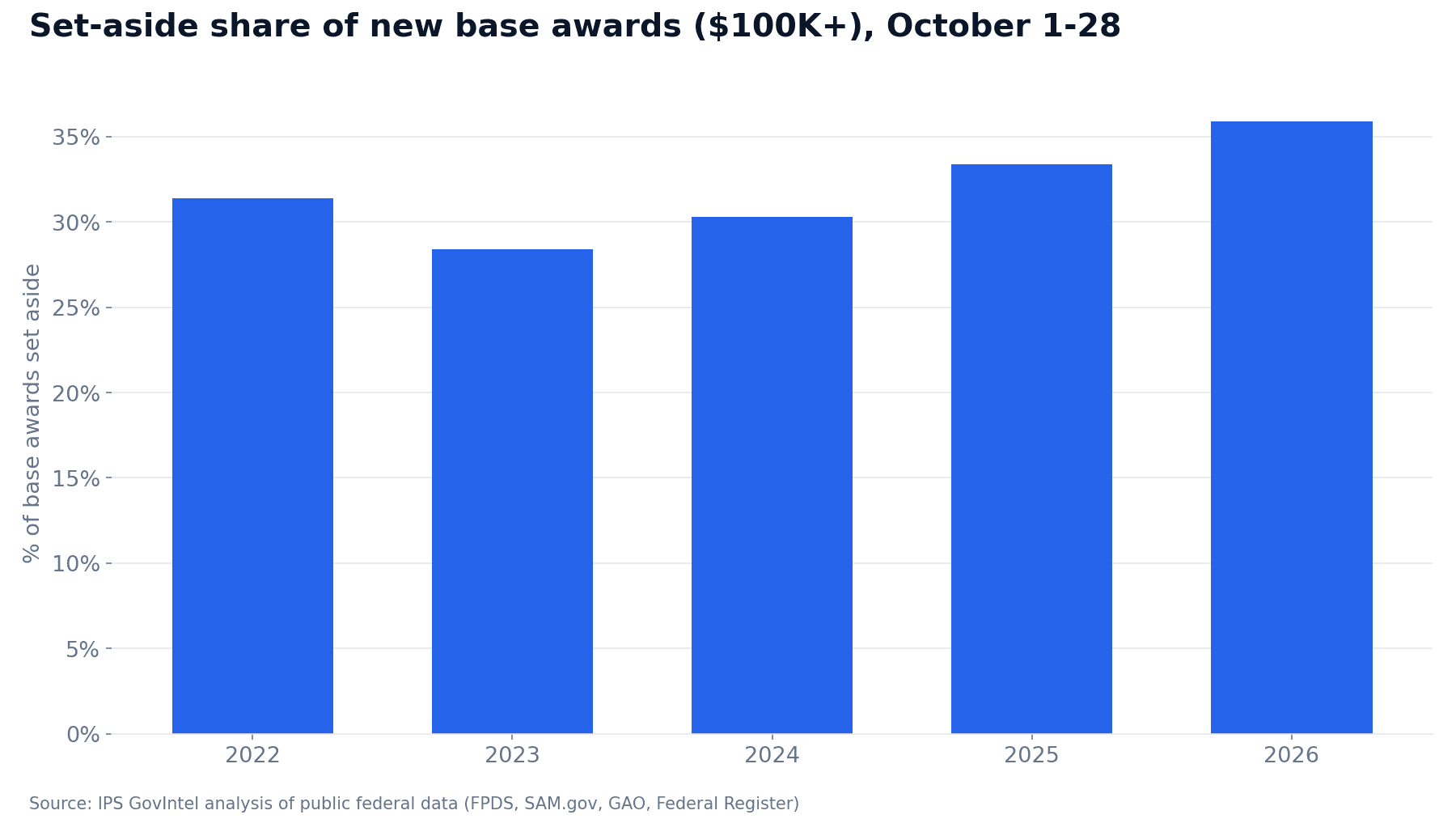
Keep the sample size in mind. 1,545 awards compares with 7,827 last October, and DoD's awards are mostly missing. When they arrive, these percentages could move.
SAM.gov notices don't carry the same FPDS lag, so for pipeline planning they're the better early signal. October 1-28, 2026 against the same window in 2025:
- Combined synopsis/solicitations: 9,558 vs. 8,545
- Solicitations: 4,286 vs. 3,679
- Sources sought: 1,957 vs. 1,497
- Special notices: 1,141 vs. 697
- Presolicitations: about the same, 1,415 vs. 1,438
Sources-sought notices are market research. More of them in October means agencies are asking questions now. I can't tell you from this data which of them become solicitations.
What Q1 usually looks like
Even when the data is complete, October is not the big month. From FY2022 through FY2025, October accounted for between 25.8% and 31.8% of first-quarter obligations. December was the largest month every year, at $56.8 billion to $65.7 billion.
So plan for Q1 money to arrive late in the quarter.
What this data can't show: which programs are waiting on full-year funding, how much new-start work is being held back, and what DoD's real October looks like. We'll know more on DoD once FPDS catches up, around the end of January.
What to do with this
- Don't re-forecast your DoD pipeline from FPDS yet. Use announcements and agency signals until late January. When you read announcements, look at the obligated amount, not the ceiling.
- Respond to sources sought now. There were 1,957 in the first four weeks, up from 1,497. This is when you can still affect how a requirement gets written.
- If you sell services to civilian agencies, check your pipeline there. Energy, NASA, HHS, GSA and Justice are all ahead of last October's pace, though single large awards can drive these numbers.
- Plan cash for a December-heavy quarter. Line up working capital and hiring timelines to match.
- Check your set-aside eligibility and vehicle positions before the Q2 solicitations arrive.
October tells you who's spending early. December tells you how big the quarter really is.
Want this kind of read on your own pipeline or market? Get in touch.
Topics
Josh Parker
Founder of Indy-Pendent Solutions and flowState Software. Former Air Force combat rescue pilot, defense program manager, and capture strategist with 20+ years in defense acquisition.
Meet GovTrace
The data warehouse behind our weekly market Insights: contract history, notices, decisions, policy, and hiring, connected around the clock.