Start with this number: in FY2025, $580.3 billion in federal obligations went through contract actions coded as not using commercial products and services procedures. Only $264.4 billion went through them.
That's the context for M-26-12, "Increasing the Acquisition of Commercial Products and Services," which OMB's Office of Federal Procurement Policy issued on April 17. The same day, the FAR Council posted guidance to implement EO 14398 (the order titled "Addressing DEI Discrimination by Federal Contractors"). GSA followed on April 20 with MV-2026-02, which applies that order to non-FAR-based contract-like instruments. Those are separate from the commercial-first memo, but they landed in the same week, and they are all worth reading.
I won't guess at how agencies will implement M-26-12. The title makes the direction clear. What the public record can show is how big the commercial channel already is, which agencies use it, and which parts of the FAR have been changing.
💡 From the GovIntel desk this week
- $14.2 billion — Homeland Security obligations, Oct 1, 2025 to Jan 22, 2026, up from $5.5 billion in the same window a year earlier. Big swings shift where new work shows up. DoD data lags about 90 days.
- $6.0 billion — Total small-business set-aside obligations in FY2026 to Jan 22, down from $6.9 billion in the same FY2025 window.
- $1.65 billion — Service-disabled veteran-owned set-aside obligations, FY2026 to Jan 22, up from $1.35 billion a year earlier.
- 126 new total small-business set-aside notices (solicitations, presolicitations, sources sought) posted the week ending April 22, down from 152 the prior week.
- 17 of 19 GAO protest decisions in the 30 days to April 22 were denials, versus 10 denials in the prior 30 days.
- $156 billion — FY2027 defense-wide RDT&E request, versus $42.8 billion in the prior request. It is the largest account increase in the budget data.
Data as of April 22, 2026, from IPS GovIntel: federal awards, opportunities, protests, rules and budgets, updated daily.
The commercial channel handles most of the actions but not most of the dollars
We track this in GovIntel, our federal contracting data warehouse. Here are FY2025 positive obligations (October 1, 2024 through September 30, 2025), split by how each action was coded:
- Commercial products/services procedures used: 3,705,314 actions, $264.4 billion
- Commercial procedures not used: 1,926,122 actions, $580.3 billion
- Pursuant to FAR 12.102(f): 43,517 actions, $2.2 billion
- Services pursuant to FAR 12.102(g): 381 actions, $0.2 billion
- DoD Section 803 CSO procedures: 52 actions, $0.1 billion
Commercial procedures cover nearly twice as many actions as non-commercial ones, but the dollars are lopsided the other way: $264.4 billion against $580.3 billion. Commercial buys are many and smaller. The big-ticket work sits outside Part 12.
That gap didn't close last year. In FY2024, commercial obligations were $259.3 billion and non-commercial were $532.8 billion. In FY2025, commercial edged up to $264.4 billion while non-commercial rose to $580.3 billion.
Which agencies already buy commercially, and which don't
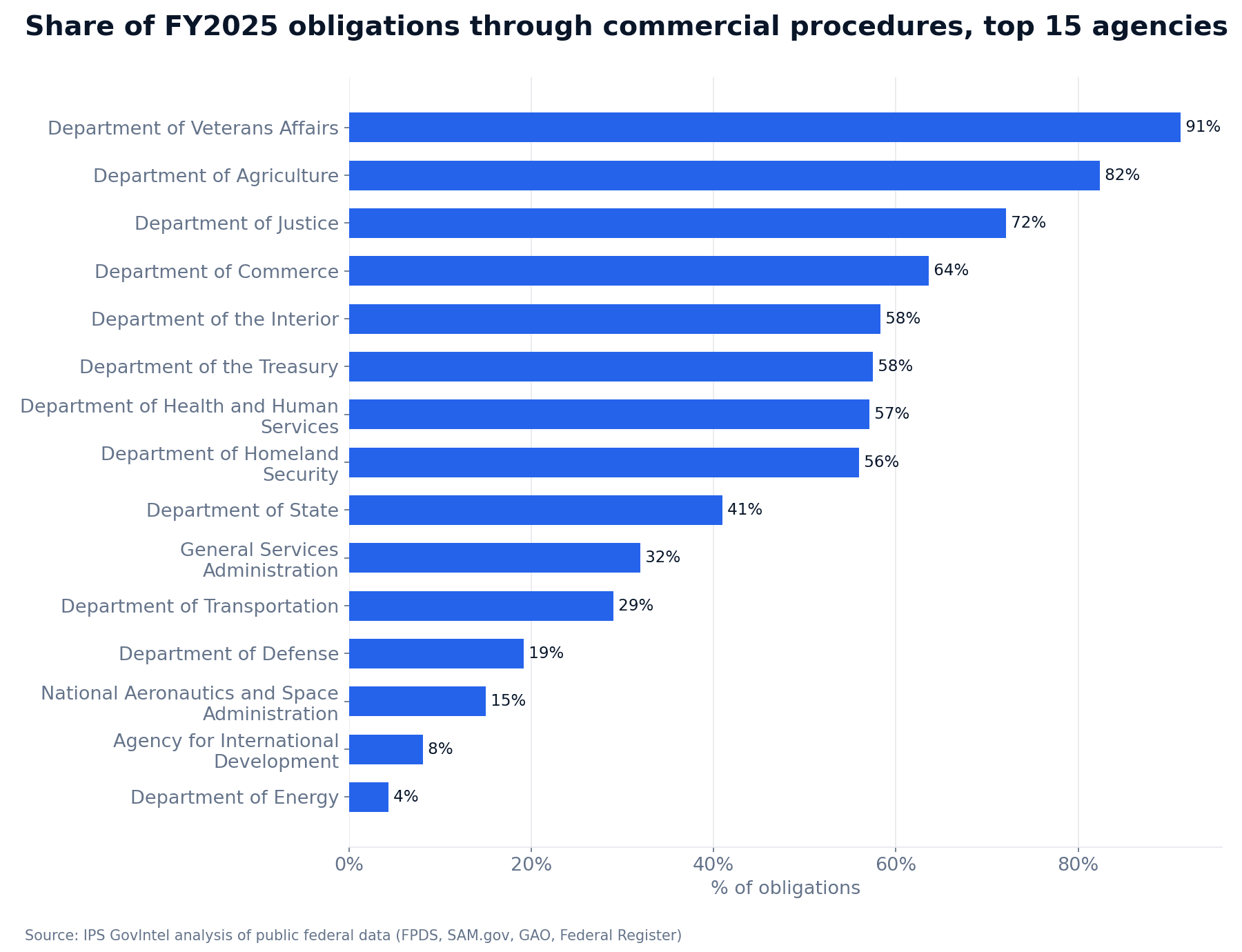
The spread between agencies is wide:
- Department of Veterans Affairs: $80.5 billion obligated, 91.2% through commercial procedures
- Agriculture: 82.4%. Justice: 72.1%. Commerce: 63.6%.
- Department of Defense: $521.8 billion obligated, 19.2% commercial
- Energy: $52.5 billion, 4.3%. NASA: 15.0%. USAID: 8.1%.
GSA runs the Schedules, yet only 32.0% of its own obligations went through commercial procedures.
If commercial-first policy moves anything in a measurable way, it will be at DoD. One percentage point of DoD's FY2025 base is worth more than everything Commerce obligated that year ($4.4 billion). VA has little room left to grow. DoD has a lot.
One caveat: DoD award data lags about 90 days. FY2025 closed on September 30, 2025, and this data runs through January 22, 2026, so the year should be mostly complete. Late modifications may still be missing.
Small-business dollars already lean commercial
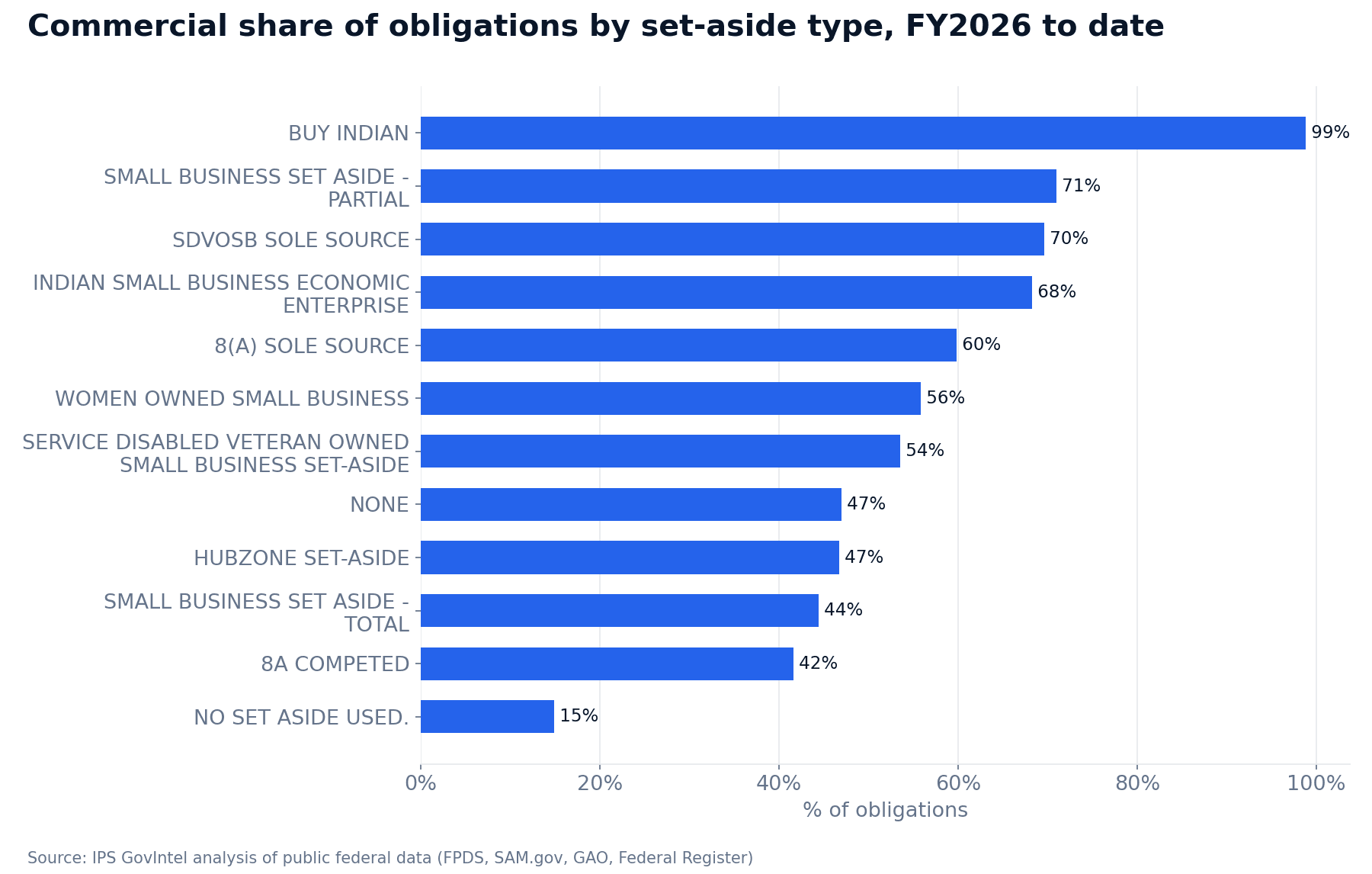
For FY2026 to date (October 1, 2025 through January 22, 2026), awards made through small-business programs went through commercial procedures far more often than awards coded "no set aside used":
- Total small business set-asides: $5.97 billion, 44.4% commercial
- SDVOSB set-asides: $1.65 billion, 53.5%
- 8(a) sole source: $1.4 billion, 59.8%
- 8(a) competed: $0.72 billion, 41.6%
- "No set aside used": $84.83 billion, 14.9%
The "NONE" bar in the chart covers actions where the set-aside field is blank ($101.42 billion, 47.0% commercial). I'd treat it as its own category, not as unrestricted competition. And because DoD data lags, these FY2026 shares are early numbers that could move.
If you're a small business, Part 12 is probably already where you live. The data can't tell you whether that holds for your specific agencies and NAICS codes, so check your own history.
Where the rulebook is moving
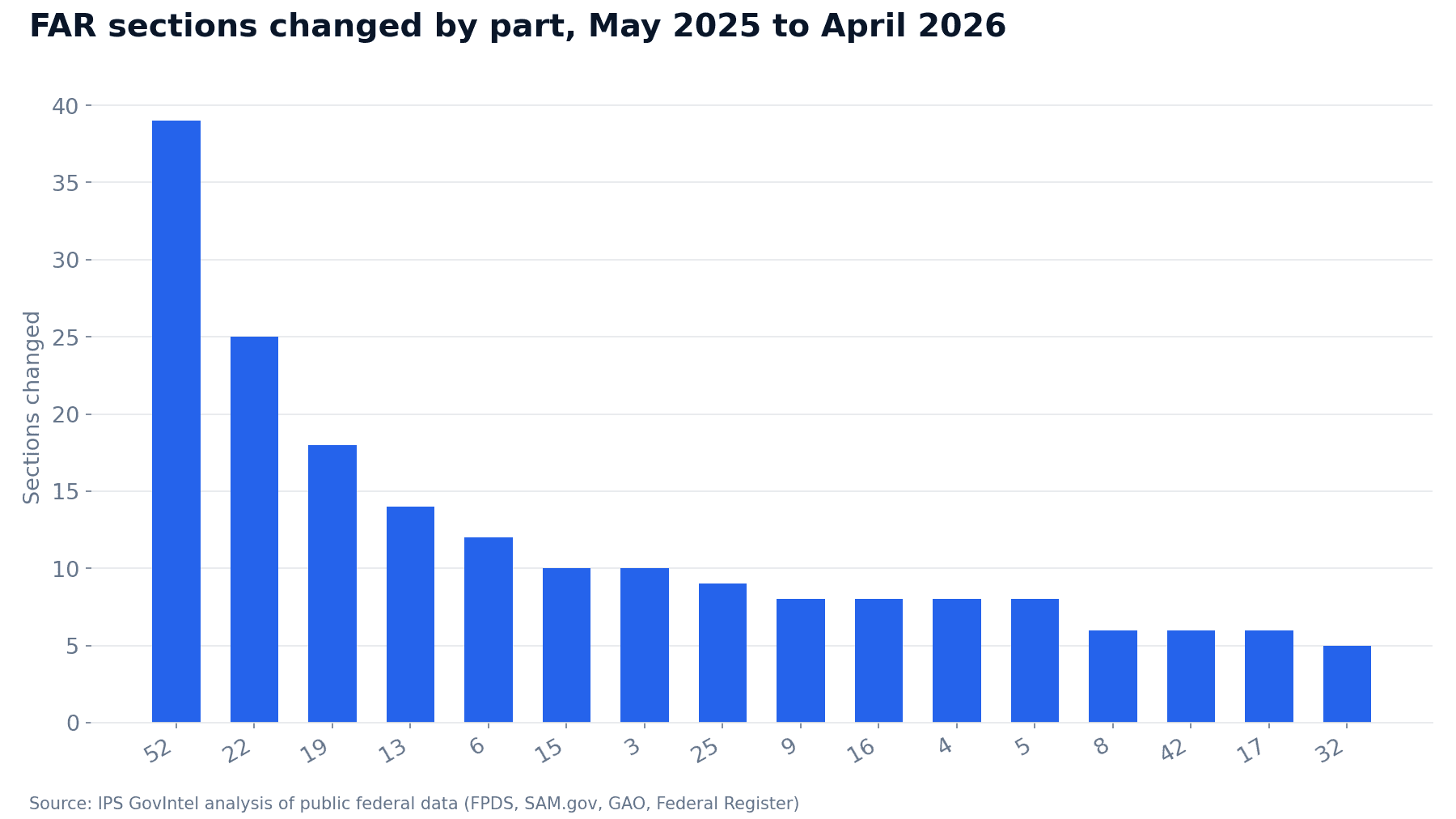
From May 2025 through April 2026, the FAR parts with the most section changes were:
- Part 52 (clauses): 39
- Part 22 (labor): 25
- Part 19 (small business): 18
- Part 13 (simplified acquisition): 14
- Part 6 (competition): 12
- Parts 15 and 3: 10 each
Every one of those changes was flagged substantive, and none were removals. For scale, May 2024 had 168 FAR sections changed and January 2025 had 122.
Rulemaking is also paying more attention to Part 12. In 2026 so far, rulemaking documents cited FAR Part 12 30 times across 11 documents. In all of 2025 it was 5 citations in 5 documents, and in 2024 it was 8. Decisions have stayed steady: 11 mentions in 2026 to date, compared with 13 in 2025.
These are the specific commercial and simplified-acquisition sections amended since October 1, 2025:
- October 1, 2025: 12.102 (Applicability) and 12.203 (solicitation, evaluation and award); Part 13 sections 13.000, 13.003, 13.201, 13.303-5, 13.402, 13.500 and 13.501; clauses 52.212-3, 52.212-5, 52.244-6, 52.204-8, 52.209-12, 52.215-12, 52.215-13, 52.222-50 and 52.222-56
- March 13, 2026: 52.204-8, 52.212-5, 52.213-4 and 52.222-19
Note that 52.212-5 and 52.204-8 were each amended twice in that window. 52.212-5 is the statutes-and-executive-orders clause for commercial contracts, and 52.204-8 is your annual reps and certs.
This data has limits. It counts how many sections changed, not how much each one changed, so a one-line conforming edit counts the same as a rewrite. It also tracks only codified text in Title 48. Class deviations and agency guidance that haven't been codified won't appear here.
What to do with this
- Re-read 52.212-5 and 52.212-3 against the current eCFR, not the version in your proposal template. Then check your flowdowns under 52.244-6.
- Refresh your SAM representations. 52.204-8 changed twice in about six months, so don't assume last year's answers still fit.
- Build your commerciality case before someone asks for it. Read 12.102 closely, and gather catalog pricing, commercial sales history and market evidence. This matters most if you sell to DoD, where only 19.2% of FY2025 obligations went through commercial procedures.
- If you work below the simplified acquisition threshold, re-read the amended Part 13 sections (13.003, 13.201, 13.303-5, 13.402, 13.500 and 13.501) and 52.213-4.
- Read M-26-12 and the FAR Council's EO 14398 guidance yourself, then watch for agency deviations. Summaries, including this one, are no substitute for the source documents.
The rules are being rewritten while you're bidding under them. Read the current text before you sign.
Want this kind of read on your own pipeline or market? Get in touch.
Topics
Josh Parker
Founder of Indy-Pendent Solutions and flowState Software. Former Air Force combat rescue pilot, defense program manager, and capture strategist with 20+ years in defense acquisition.
Need help with your next capture?
Our software tools can help you win more government contracts.