In September 2026, the Department of Defense announced 24 contracts that mention counter-UAS. Together they're worth $8.4 billion.
For comparison, contract actions in FPDS whose descriptions mention counter-UAS add up to $341.8 million in obligations for all of FY2026 (October 2025 through September 2026).
Those two numbers measure different things. DoD announcements often carry the full ceiling of a multi-year vehicle, while FPDS records the dollars actually obligated so far. DoD award data in FPDS also runs about 90 days behind, so FY2026's late-summer actions are still filling in. Even with those caveats, the gap tells you something. Counter-drone work is no longer just a line item buried inside a bigger program. Agencies increasingly buy it as its own category, with its own vehicles, notices and budget lines.
We track this in GovIntel, our federal contracting data warehouse, so I pulled the public record on it.
💡 From the GovIntel desk this week
- $985 million is the shared maximum on a five-year, no-option DLA base-supply contract announced Nov 13, awarded to at least 10 small-business organizations.
- $11.9 billion in small-business DoD announcements this week versus $402 million the prior week; the shared maximum is likely counted once per awardee, inflating the total.
- 24 announcements, $985 million: other-than-small DoD awards fell sharply from 51 and $49.9 billion the week before. Weekly totals swing with a few large deals.
- 1,330 new SAM.gov solicitations this week were total small-business set-asides, alongside 176 SDVOSB and 70 HUBZone set-asides, so the set-aside pipeline stays deep.
- 10 GAO protests were filed this week, down from 31 the week before. One week is a thin sample, and recent filings may be incompletely recorded.
- 4.34% is the 12-month rise in private-industry wages and salaries in Q3 2026 (total compensation 4.31%), a useful benchmark when pricing labor in long-term bids.
Data as of November 18, 2026, from IPS GovIntel: federal awards, opportunities, protests, rules and budgets, updated daily.
Fewer dollars per award, many more vendors
Here is the fiscal-year view of FPDS actions with counter-UAS language in the description:
- FY2024: $522.8 million across 101 awards and 60 vendors
- FY2025: $345.7 million across 126 awards and 84 vendors
- FY2026: $341.8 million across 172 awards and 98 vendors (still filling in because of the DoD lag)
Reported obligations went down, while awards and vendors went up every year. FY2024 was lumpy: August 2024 alone accounted for $193.4 million. Since then the money has spread across more awards. September 2025 had 50 actions on 40 different awards, the busiest month in the October 2023 to October 2025 monthly data I reviewed.
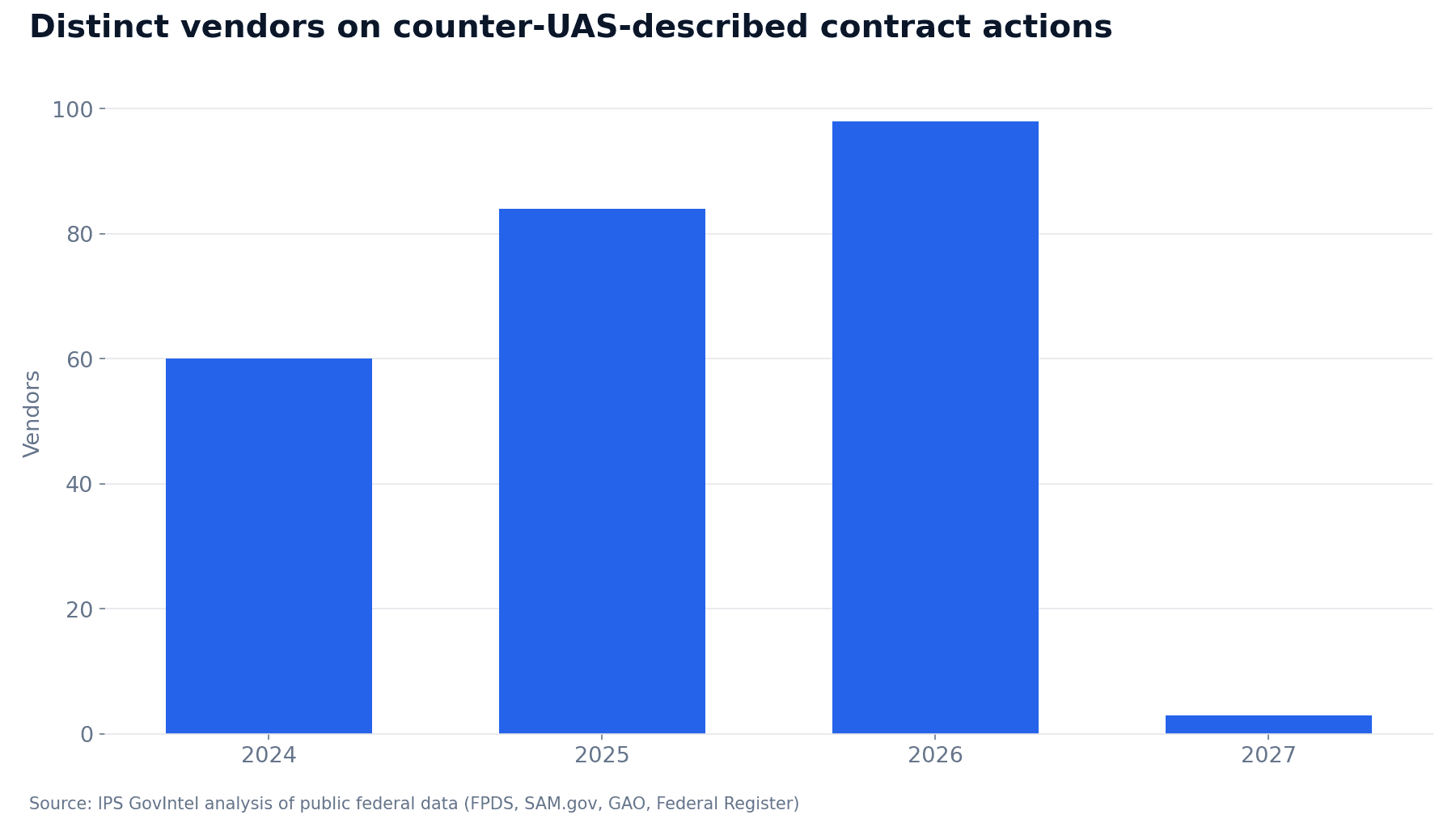
For a small contractor, that is the useful trend. A market with 98 vendors and 172 awards has more seats at the table than one where a few big actions carry the year.
The data can't show C-UAS work that's described generically ("integration support," "sensor upgrades") or that sits inside a larger program's description. Read these figures as a floor.
Who's buying, and who's getting paid
The Army is the anchor. In FY2026 it obligated $93.2 million across 78 counter-UAS actions. After that the list gets more varied than most people would guess:
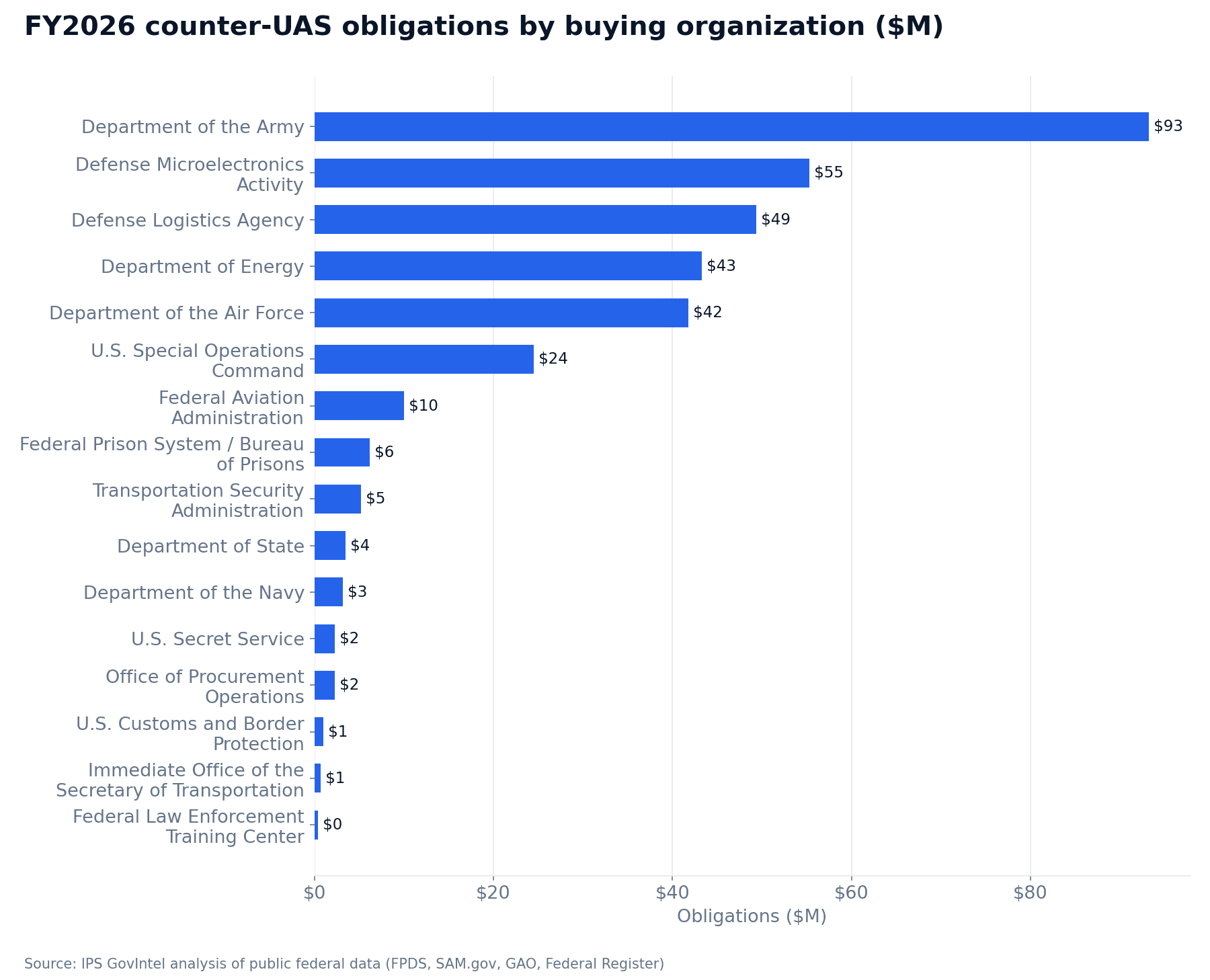
The Defense Microelectronics Activity ($55.3 million) and the Defense Logistics Agency ($49.4 million) both obligated more than the Air Force ($41.8 million across 58 actions). The Department of Energy obligated $43.3 million. SOCOM came in at $24.5 million.
The civilian side is smaller but real: the FAA at $10.0 million, the Bureau of Prisons at $6.2 million, TSA at $5.2 million, and a scattering of DHS components. DHS's Office of Procurement Operations logged 17 actions for $2.3 million, and CBP logged 4 actions for $1.0 million. The Navy logged 27 actions but only $3.2 million.
On the recipient side, the top of the FY2026 table is mixed:
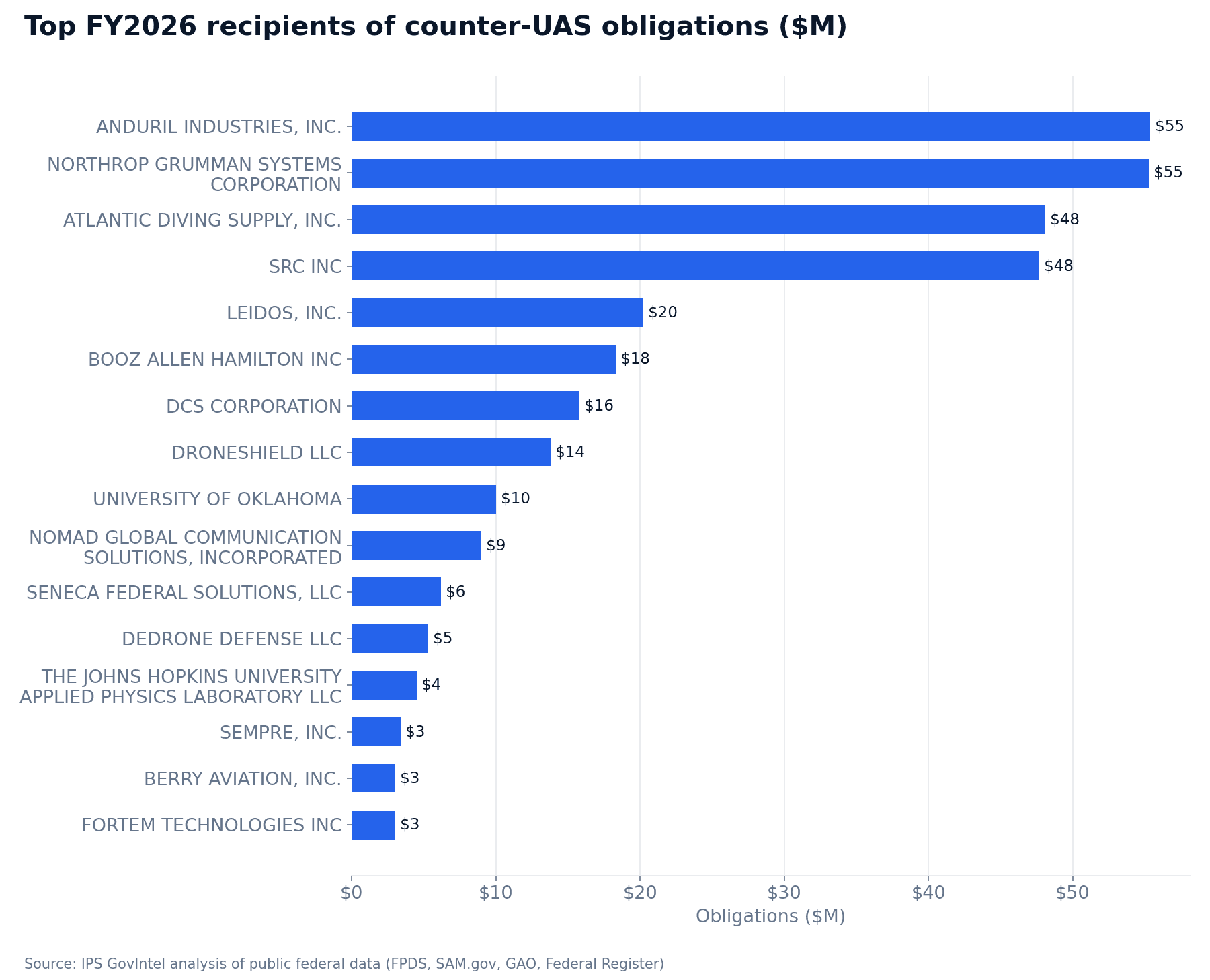
Anduril ($55.4 million over 16 awards), Northrop Grumman ($55.3 million), Atlantic Diving Supply ($48.1 million over 16 awards) and SRC ($47.7 million) lead the list. Below them are integrators such as Leidos, Booz Allen and DCS, plus research organizations like MITRE and Johns Hopkins APL. There's also a group of smaller product and services firms, including DroneShield ($13.8 million), Seneca Federal Solutions ($6.2 million) and Fortem ($3.0 million).
One caution on size: FPDS size coding is per action. A firm can be coded small on some actions and not on others, so check the coding before you build a teaming assumption on it.
How the dollars were competed
This is where small businesses should pay the most attention. FY2026 counter-UAS obligations, by how they were competed and the recipient's coded size:
- Not competed, other-than-small: $110.6 million (57 actions). That's roughly a third of the total.
- Full and open, other-than-small: $102.5 million (92 actions)
- Full and open after exclusion of sources, small business: $70.0 million (46 actions). This is how FPDS records set-asides.
- Full and open, won by small business: $19.8 million (22 actions)
Set-asides are the biggest single source of small-business counter-UAS dollars, at $70.0 million. Small firms also won $19.8 million in full and open competition, plus about $13.7 million under simplified acquisition procedures. This category is not closed to small firms. The not-competed dollars are harder to reach as a prime, and the data doesn't say why they weren't competed.
Where the new requests are showing up
SAM.gov notices. I matched on notice titles. The rows I have run through July 2026. Sources sought was the most common type in five of those nine months, with 10 in November 2025 (6 with a set-aside) and 12 in June 2026. July 2026 looked different: 11 combined synopsis/solicitations, 10 of them carrying a set-aside, against 7 sources sought. Whether that holds after July, I can't tell from this pull.
Outside SAM.gov. Some of this work never shows up on SAM. Three counter-UAS DoD SBIR/STTR topics are listed as current, posted between September 2 and October 7, 2026. One NSTXL consortium posting was awarded on September 29, 2026. If you only watch SAM, you'll miss these.
The FY2027 budget request. This is the forward signal. Army counter-UAS lines in the FY2027 request:
- Counter Small UAS procurement: $994.1 million, up 66.8%
- Counter-UAS Development: $359.2 million, up 155.8%
- C-SUAS Advanced Technology: $156.5 million, against $7.8 million in the prior request
- C-SUAS Applied Research: $26.5 million, against $12.6 million
The Navy has its own C-UAS line at $20.8 million. A request isn't an appropriation. Still, the Army's advanced technology line growing roughly twentyfold is a readable signal: prototyping and transition money may be coming, and that's where SBIR firms and small integrators usually come in.
What to do with this
- Map the second tier of buyers. The Army is the obvious one. DLA, DMEA, DOE, SOCOM, the FAA and the Bureau of Prisons all obligated real counter-UAS money in FY2026. Find their contracting offices and requirement owners.
- Answer the sources sought notices. A response is one of the ways a contracting officer tests whether small businesses can do the work. Many of the set-aside solicitations followed that kind of market research.
- Watch the SBIR and consortium channels. The SBIR/STTR topics and consortium postings sit outside SAM. Put them on your weekly scan.
- Line up your offering with the FY2027 R&D lines. Advanced technology and development are the lines growing fastest. Integration, test, sensor fusion and site-survey work fits there better than competing head-on in product buys.
- Check size coding before you team. Look at how a potential partner's past counter-UAS actions were actually coded before you count on a set-aside strategy.
The money is there. The work is figuring out which of these channels your company can actually win in.
Want this kind of read on your own pipeline or market? Get in touch.
Topics
Josh Parker
Founder of Indy-Pendent Solutions and flowState Software. Former Air Force combat rescue pilot, defense program manager, and capture strategist with 20+ years in defense acquisition.
Meet GovTrace
The data warehouse behind our weekly market Insights: contract history, notices, decisions, policy, and hiring, connected around the clock.