The largest "extension" justification posted since November 2025 carried a stated value of $1.24 billion. That was the National Geospatial-Intelligence Agency's EMERALD Extension, posted January 12, 2026, under the only-one-source authority.
That one is an outlier. The pattern around it is not. Every month from September 2025 through September 2026, between 4.2% and 9.3% of all Justification & Approval (J&A) notices had "bridge," "extension" or "interim" in the title. In FPDS, contract modifications that mention "bridge" in their description ran from 160 in October 2025 to a peak of 371 in March 2026.
If you're timing a recompete off the incumbent's end date, expect that date to be soft.
💡 From the GovIntel desk this week
- $4.17 billion shared ceiling on an Army ammunition plant award; at least 10 firms listed, 11 offers. The same figure repeats per firm, so it isn't $4.17B each.
- 1,512 small business set-aside solicitations posted this week, up from 1,353 the week before (about 12%). More set-aside work is being offered.
- 208 new SDVOSB set-aside solicitations versus 198 the prior week; HUBZone eased slightly to 93 from 96. Small, steady shifts.
- 1,607 unrestricted solicitations and combined synopses posted, versus 1,561 the prior week. Open competition still makes up a large share of new notices.
- 16 of 66 DoD award rows this week were to small businesses, worth about $826 million. DoD award data lags roughly 90 days.
- 15 sections of Part 9904 (Cost Accounting Standards) changed in October 2026, 11 of them removed. Check whether your accounting practices touch those sections.
Data as of November 11, 2026, from IPS GovIntel: federal awards, opportunities, protests, rules and budgets, updated daily.
How common bridges are
We track this in GovIntel, our federal contracting data warehouse, by pulling every posted J&A and flagging the ones whose title says bridge, extension or interim. The window here runs from September 2025 through early November 2026.
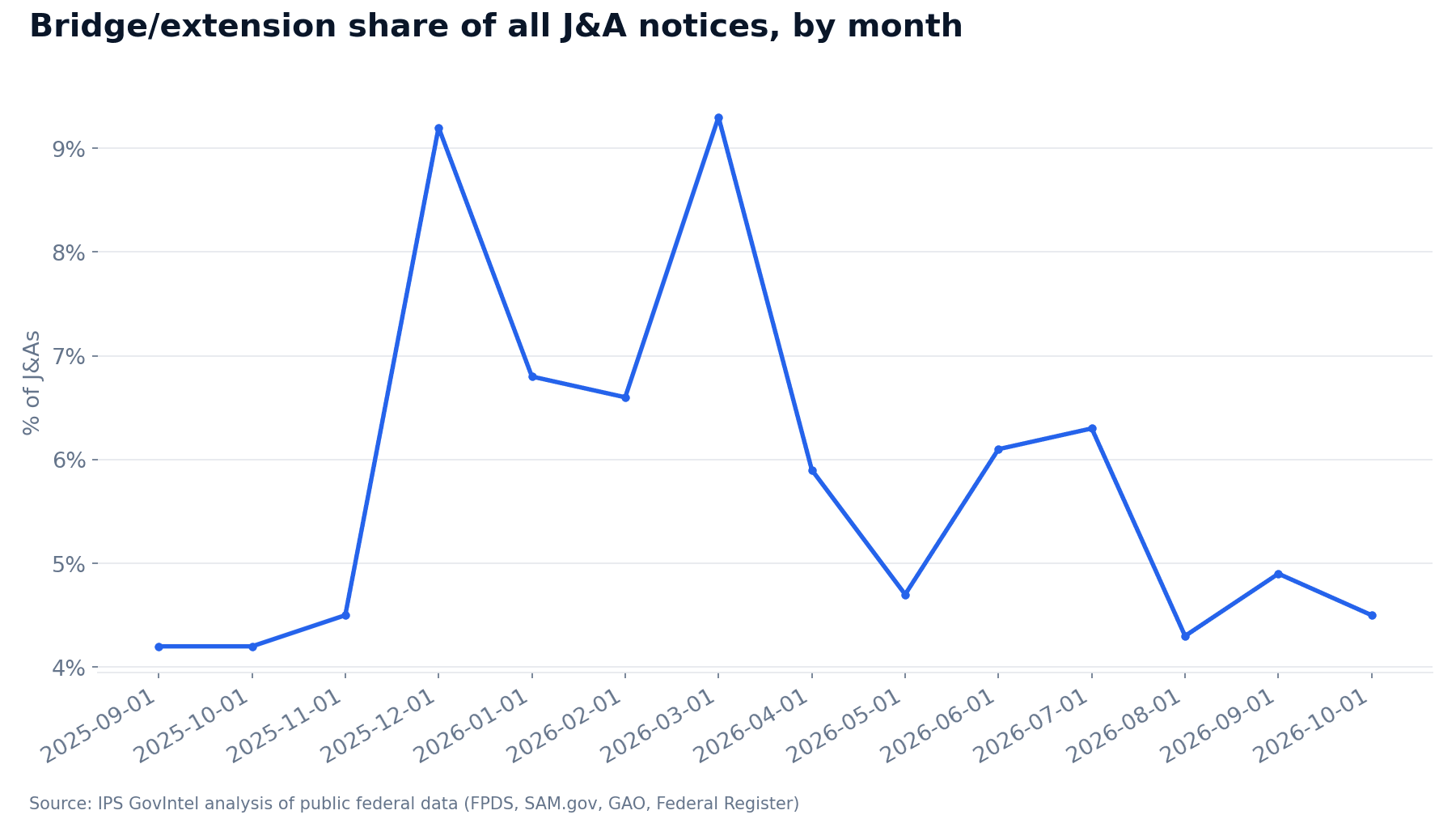
The share isn't flat. It peaked at 9.2% in December 2025 (34 of 371 J&As) and 9.3% in March 2026 (48 of 516). From April through September 2026 it ran between 4.3% and 6.3%. September is busy in absolute terms, simply because everything is busy in September: in September 2026, 40 of 816 J&As were bridge-type.
The dollar figures swing much more than the counts. October 2025 bridge notices added up to $3.0 billion, but the median notice was $750,000. A few very large actions drive the total. January 2026 totaled $2.4 billion.
Some caveats:
- Duplicates inflate totals. The same requirement often gets posted more than once. EMERALD shows up three times: December 4 at $1.185 billion, then January 12 at both $1.244 billion and $1.185 billion. The Army's operation and maintenance extension at BAMC, JBSA, Texas appears three times at $249 million each. Read the totals as an upper bound.
- Title matching undercounts. A bridge that isn't called a bridge in the title won't show up here.
- October 2026 is partial. Only 88 J&As have landed for the month so far, so the 4 bridge notices tell you nothing yet.
Who bridges, and under what authority
Since November 2025, the Department of Defense posted 139 bridge or extension J&As worth $5.9 billion on stated value (with the duplicate caveat above). Homeland Security was second with 55. The largest was a $468 million period-of-performance extension on a CBP Low-Energy Portal Systems IDIQ. GSA posted 33, VA 31 and HHS 19.
Among bridge-type J&As, 78 cited only one responsible source. Agencies cited urgency 26 times, out of 268 urgency J&As in the period. FSS limited sources appeared on 18 (of 165) and the IDIQ fair-opportunity exception on 16 (of 182). Another 184 didn't parse to a clear authority, so this breakdown is directional at best.
The J&A feed shows only part of what's happening. The modification data shows more:
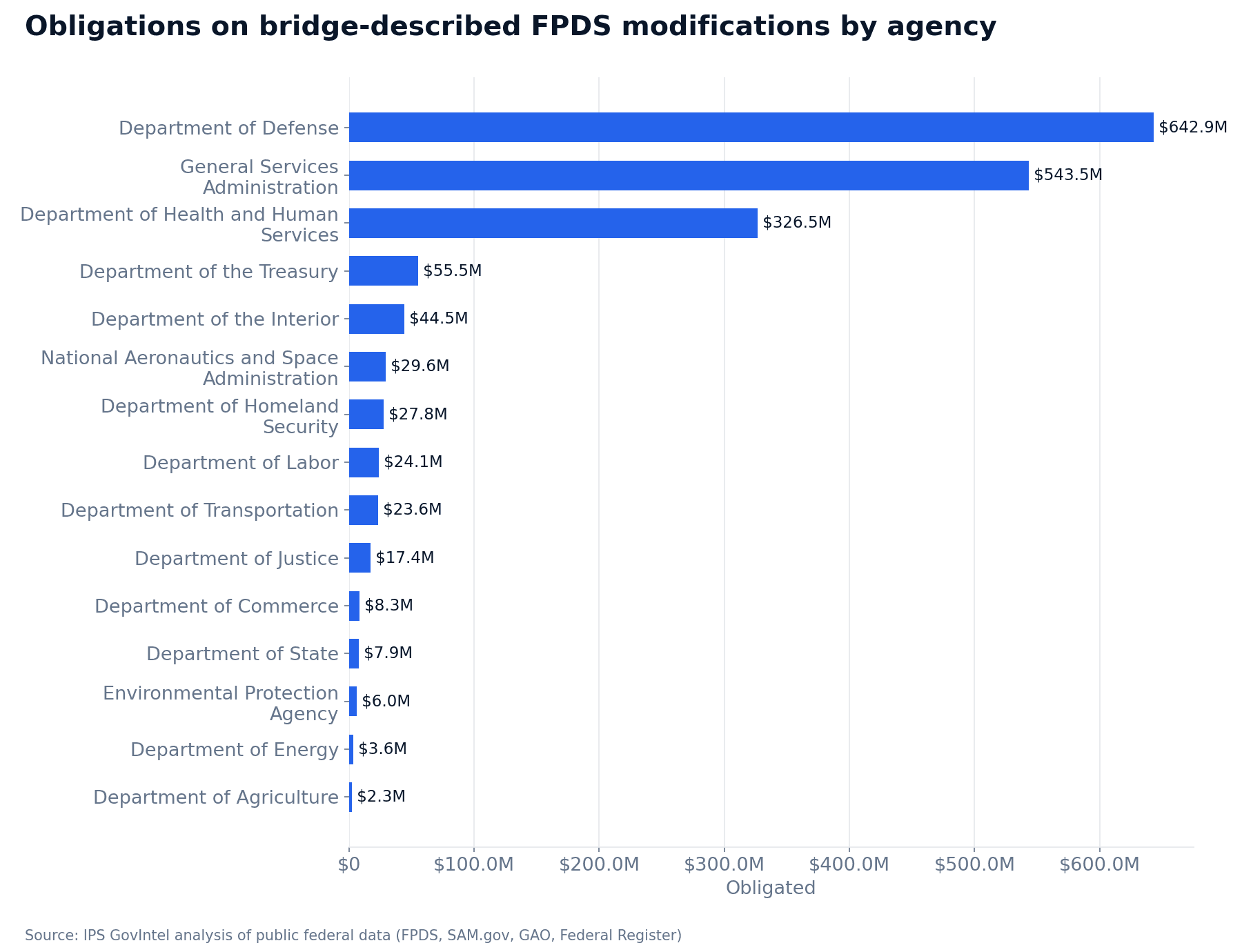
From November 2025 to October 2026, DoD logged 931 bridge-described mods carrying $642.9 million across 445 awards. GSA had 287 mods worth $543.5 million on just 83 awards. Compare that with GSA's 33 J&A notices, only one of which carried a stated value ($832,204). HHS had 81 mods worth $326.5 million. Transportation (203 mods on 129 awards) and Agriculture (136 mods on 100 awards) show bridge language often but in small dollar amounts.
The takeaway: at some agencies, you won't find bridges by watching J&A postings. You'll find them in the mod history of the award itself.
More bridge mods sit on competed awards than on sole-source ones
This is the part I'd want a small-business owner to absorb.
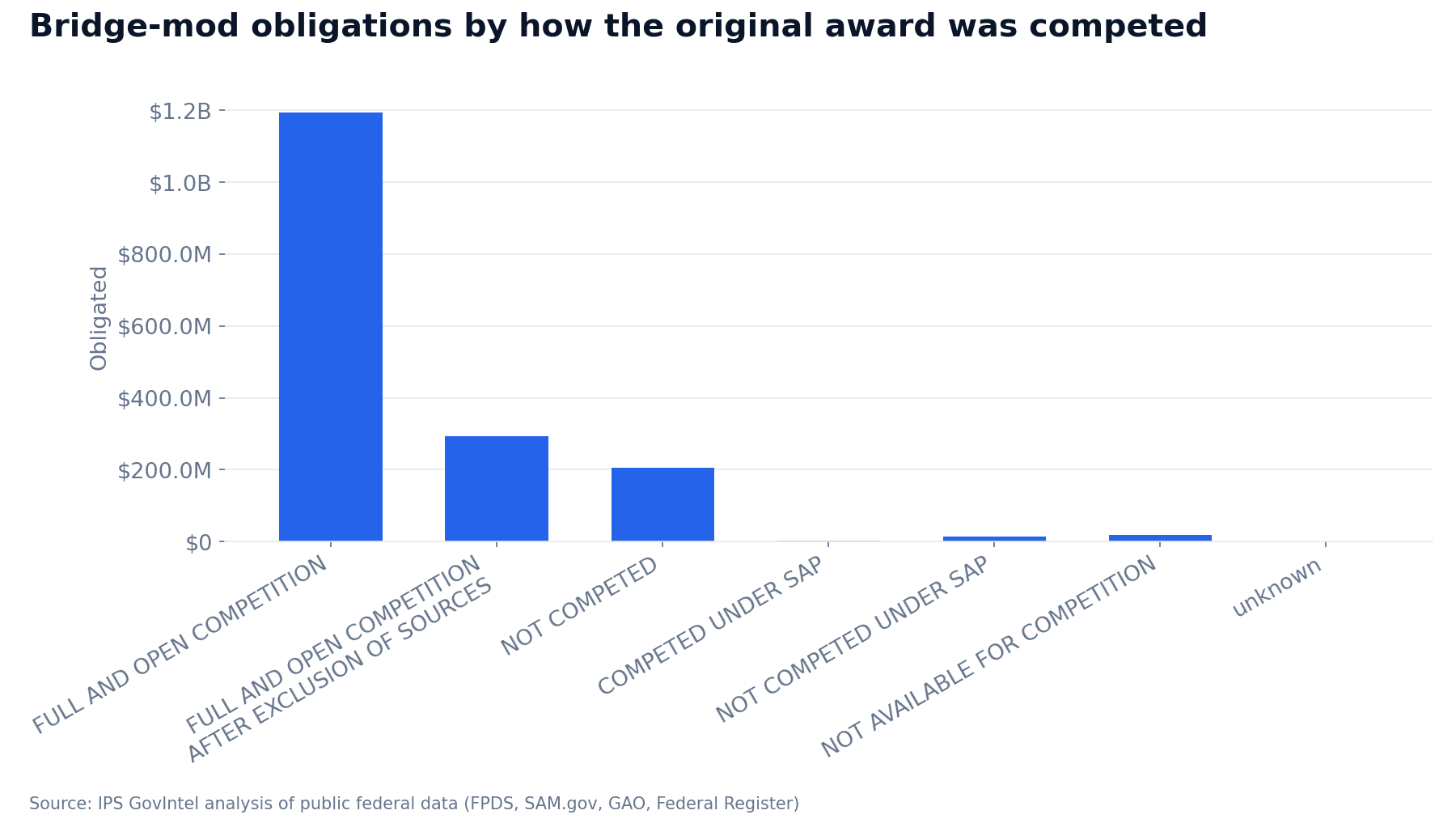
Since November 2025, the largest group of bridge-described mods sat on actions coded full and open competition: 1,176 mods on 530 awards, carrying $1.2 billion. Next came awards competed after exclusion of sources, a category that includes set-asides: 531 mods on 313 awards, $293.6 million. Awards coded not competed accounted for 523 mods on 275 awards and $205.2 million.
So bridges aren't mainly a sole-source story. Plenty of them attach to work that was competed in the first place. The data doesn't say why. A competed contract running out before its recompete is ready is the obvious suspect, but I can't prove that from these fields. Also, "bridge" in a mod description doesn't always mean a formal bridge contract.
What the data can't show yet
I wanted to show how far end dates slip on contracts expiring in the next 24 months, using first-versus-latest period-of-performance dates in FPDS. Those queries timed out, so I'm not going to estimate it. Without it, I can't tell you how often a recompete date moves, only that bridge language is common.
The J&A titles do give a sense of the time periods involved. The Army's MCTP Bridge Period 2 was a 5-month extension worth $42.5 million, justified on urgency. A separate Army hardware-in-the-loop aviation requirement got a one-year bridge worth $49.6 million under a fair-opportunity exception. Two examples aren't a distribution. "Period 2" does suggest that bridge had already been extended once.
One more caveat: DoD award data lags about 90 days. The low FPDS counts for September 2026 (48 mods) and October 2026 (88) most likely reflect reporting lag. They don't mean agencies stopped bridging.
What to do with this
- Treat the incumbent's end date as a soft date. Before you set a capture timeline, pull the award's modification history and search the descriptions for "bridge" and "extend." Build slack into the schedule.
- Watch both feeds. J&A notices catch the large sole-source bridges. FPDS mods catch the rest, especially at agencies like GSA where very little shows up as J&A value.
- Read the J&A text when one posts. Bridge justifications often state why the follow-on isn't ready and what period the agency wants to cover. That's schedule information you won't get elsewhere.
- If you're the incumbent, have a bridge price ready. Know what it costs you to run 5 months or a year past the planned end date, including retention, so you're not pricing it under deadline pressure.
- Budget for a longer capture. If a recompete slips, your B&P spending and relationship-building have to last longer too.
Treat the end date as a plan, not a promise.
Want this kind of read on your own pipeline or market? Get in touch.
Topics

Josh Parker
Founder of Indy-Pendent Solutions and flowState Software. Former Air Force combat rescue pilot, defense program manager, and capture strategist with 20+ years in defense acquisition.
Meet GovTrace
The data warehouse behind our weekly market Insights: contract history, notices, decisions, policy, and hiring, connected around the clock.